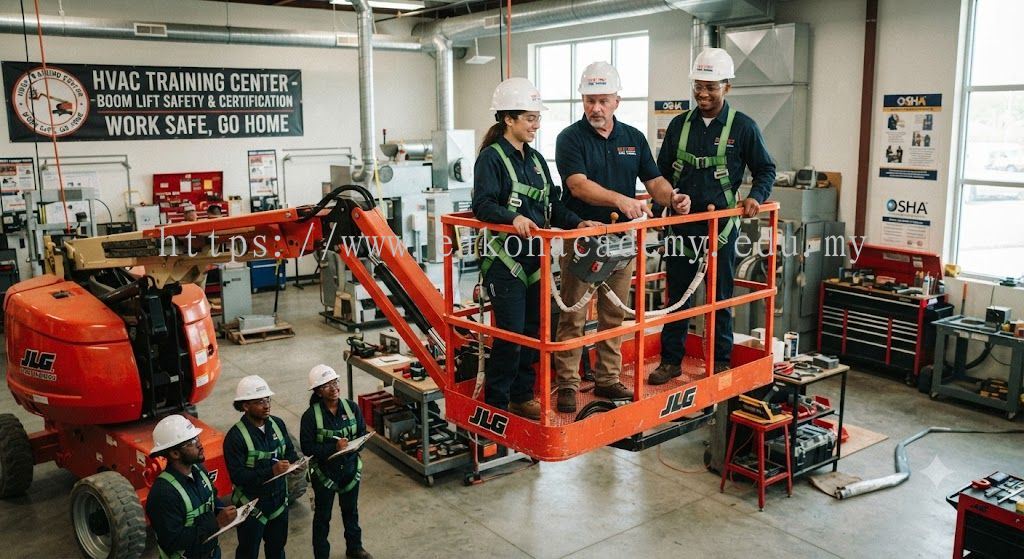
Boom Lift Safety Training for HVAC Work: Essential Working at Height Skills for Air Conditioning Professionals
Working at height is a common requirement in the HVAC industry, particularly during the installation, servicing, inspection, and maintenance of air conditioning systems in commercial buildings, factories, shopping malls, warehouses, hospitals, airports, and high-rise developments. Many HVAC components, including rooftop condensing units, cooling towers, ventilation systems, ductwork, and large VRF or VRV systems, are installed in locations that require safe access equipment. Boom lift safety training for HVAC work provides technicians with the practical knowledge and hands-on experience needed to safely operate boom lifts while performing air conditioning tasks at elevated heights. At Eakon Academy (eakonacadem.edu.my), we are committed to developing competent HVAC professionals through comprehensive technical and workplace safety training that combines industry best practices with practical operating skills. Our training prepares technicians to work safely, efficiently, and confidently while meeting workplace safety standards throughout Malaysia.
A boom lift, also known as an articulating boom lift or telescopic boom lift depending on its design, is a type of Mobile Elevated Work Platform (MEWP) that allows technicians to reach difficult or restricted work areas. Unlike traditional ladders or fixed scaffolding, boom lifts provide greater flexibility by extending both vertically and horizontally, making them ideal for accessing rooftop HVAC equipment, building façades, suspended mechanical systems, ceiling-mounted air conditioning units, and elevated service platforms. However, because boom lifts are powerful machines capable of reaching significant heights, proper operator training is essential to prevent accidents such as falls, tip-overs, collisions, entrapment, electrical contact, and falling objects. Professional boom lift safety training ensures HVAC technicians understand how to operate this equipment responsibly while minimizing workplace risks.
One of the key learning objectives of boom lift safety training is hazard identification and workplace risk assessment. Before operating any boom lift, HVAC technicians should evaluate the worksite for potential hazards including uneven ground, unstable surfaces, overhead electrical power lines, nearby structures, confined workspaces, pedestrian traffic, moving vehicles, overhead obstructions, and changing weather conditions. Conducting a comprehensive site assessment enables technicians to select the most appropriate access equipment, establish safe work zones, and implement effective control measures before beginning air conditioning installation or maintenance activities. Proper planning significantly reduces the likelihood of workplace incidents while improving overall project efficiency.
Pre-operation equipment inspection is another fundamental aspect of boom lift safety training. Before every use, operators should inspect the machine for hydraulic leaks, damaged tyres, worn hoses, loose guardrails, faulty controls, emergency stop systems, emergency lowering functions, batteries or fuel systems, warning alarms, outriggers, and structural damage. Any mechanical defects should be reported immediately, and the equipment should not be operated until qualified maintenance personnel have completed the necessary repairs. Routine inspections help prevent equipment failure while ensuring safe operation throughout HVAC servicing or installation work.
Hands-on operator training provides HVAC technicians with practical experience using different types of boom lifts in controlled environments. Participants learn how to safely start, manoeuvre, elevate, position, and lower the platform while maintaining stability and situational awareness. Training also covers load capacity management, emergency procedures, safe travel techniques, proper platform positioning, and understanding manufacturer operating instructions. These practical exercises develop operator confidence while reinforcing safe work habits that can be applied on actual commercial and industrial HVAC projects.
Personal Protective Equipment (PPE) forms an essential part of every boom lift safety programme. HVAC technicians are trained to wear appropriate safety helmets, gloves, eye protection, high-visibility clothing, and slip-resistant safety footwear during elevated work. Unlike some other elevated work platforms, boom lifts generally require operators to wear a full-body safety harness connected to the designated anchor point inside the platform. Proper use of fall protection equipment significantly reduces the risk of serious injury in the event of sudden platform movement or unexpected impacts. Participants also learn how to inspect harnesses and lanyards before use to ensure they remain in safe working condition.
Maintaining platform stability is critical throughout every HVAC task. Boom lift safety training teaches technicians how to position the machine on stable ground, fully deploy outriggers when required, avoid exceeding the manufacturer's maximum load capacity, and distribute tools and materials evenly across the platform. Refrigerant cylinders, HVAC tools, replacement components, and testing instruments should be securely stored to prevent shifting loads or falling objects that could endanger workers below. Understanding equipment limitations helps operators avoid unsafe practices that may compromise platform stability.
Weather awareness is particularly important for outdoor HVAC work involving rooftop installations or maintenance. High winds, heavy rainfall, lightning, poor visibility, and slippery surfaces increase the risks associated with elevated work. Professional boom lift safety training teaches technicians to monitor weather conditions continuously and suspend operations whenever environmental conditions exceed the manufacturer's recommended operating limits. Protecting workers from adverse weather conditions is an essential part of maintaining a safe workplace while minimizing damage to equipment and surrounding property.
Effective communication and teamwork also contribute significantly to safe boom lift operation. HVAC projects frequently involve electricians, mechanical contractors, engineers, supervisors, and facility management personnel working simultaneously within the same area. Clear communication between boom lift operators and ground personnel helps coordinate equipment movement, establish exclusion zones, prevent collisions, and respond quickly during emergencies. Good teamwork creates a safer work environment while improving productivity on complex commercial and industrial projects.
Emergency preparedness is another important topic covered during boom lift safety training. Participants learn emergency lowering procedures, rescue planning, evacuation methods, communication protocols, and how to respond to equipment malfunctions while working at height. Understanding emergency procedures ensures technicians can react quickly and effectively during unexpected situations, reducing the severity of incidents and protecting everyone involved in the operation.
Routine preventive maintenance of boom lifts is essential for ensuring long-term equipment reliability. Regular servicing, hydraulic inspections, battery maintenance, lubrication, brake testing, tyre inspections, and scheduled mechanical servicing help keep access equipment operating safely and efficiently. Employers who maintain their boom lifts according to manufacturer recommendations benefit from reduced downtime, improved operational reliability, lower repair costs, and enhanced workplace safety.
At Eakon Academy (eakonacadem.edu.my), we are committed to providing industry-leading HVAC technical education and workplace safety training that prepares technicians for the demands of modern air conditioning projects. Our boom lift safety training for HVAC work combines classroom learning with practical hands-on experience, enabling participants to safely inspect, operate, and manage boom lifts while performing installation, maintenance, troubleshooting, and servicing tasks at height. By developing strong technical knowledge, safe operating skills, and hazard awareness, our programmes help HVAC professionals improve workplace safety, achieve regulatory compliance, increase operational efficiency, and enhance their long-term career opportunities. Whether working on residential, commercial, or industrial air conditioning systems, professional boom lift safety training is an essential investment for every HVAC technician committed to delivering safe, efficient, and high-quality services throughout Malaysia.
更多 EAKON ACADEMY SDN BHD 相关资料 Malaysia