
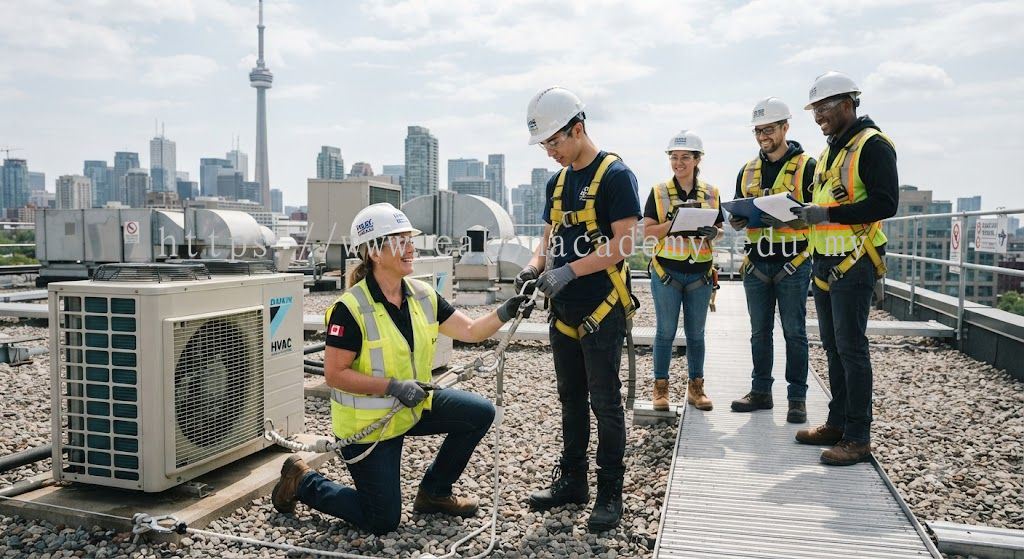
HVAC Certified Height Safety Training Air Conditioning: Professional Working at Height Certification for HVAC Technicians
HVAC certified height safety training air conditioning is a comprehensive professional certification program designed to equip air conditioning and refrigeration technicians with the knowledge, practical skills, and safety competencies required to perform HVAC installation, maintenance, servicing, and repair work safely at elevated locations. As modern HVAC systems are increasingly installed in commercial buildings, industrial facilities, residential high-rise developments, shopping complexes, hospitals, and office towers, technicians are frequently required to work on rooftops, ladders, ceiling spaces, elevated platforms, and external building structures. These environments present significant fall hazards and workplace risks that require proper training and certification. At Eakon Academy, HVAC certified height safety training combines practical learning with industry-recognized safety practices to prepare technicians for safe and professional working at height throughout Malaysia.
Working at height remains one of the highest-risk activities within the HVAC industry. Air conditioning technicians are responsible for installing split air conditioning systems, servicing rooftop package units, maintaining VRF and VRV systems, inspecting chillers, replacing compressors, installing refrigerant piping, conducting electrical testing, and performing preventive maintenance in elevated work areas. Every project introduces different challenges, including unstable surfaces, difficult access routes, changing weather conditions, overhead electrical hazards, and restricted working spaces. HVAC certified height safety training air conditioning prepares technicians to recognize these hazards, evaluate risks, and implement effective safety measures before beginning any work.
One of the core components of certified height safety training is workplace hazard identification. Before starting any installation or maintenance activity, technicians are trained to inspect the work environment thoroughly and identify potential hazards that may increase the risk of accidents. This includes evaluating rooftop conditions, roof edges, ladder positioning, ceiling access, structural stability, equipment placement, environmental conditions, and pedestrian traffic. Learning to recognize hazards early allows technicians to establish safer work procedures and minimize unnecessary exposure to danger.
Risk assessment is another essential element of HVAC certified height safety training air conditioning. Technicians learn structured methods for assessing the likelihood and severity of workplace hazards before commencing elevated work. This includes identifying potential fall hazards, selecting appropriate control measures, determining safe access methods, and ensuring that emergency procedures are established before work begins. Proper risk assessment enables technicians to make informed safety decisions while improving operational efficiency and reducing workplace incidents.
A significant portion of the training focuses on personal protective equipment (PPE) and fall protection systems. Participants receive practical instruction on selecting, inspecting, fitting, and using essential safety equipment including safety helmets, full-body harnesses, shock-absorbing lanyards, anchor connectors, lifelines, non-slip safety footwear, gloves, and eye protection. The course also explains the importance of regular PPE inspections and equipment maintenance to ensure continued reliability. Understanding the proper use of fall protection systems significantly reduces the risk of serious injuries during elevated HVAC work.
Safe ladder operation forms another important part of HVAC certified height safety training. Air conditioning technicians frequently rely on ladders when installing indoor units, servicing ceiling-mounted systems, inspecting ductwork, and accessing outdoor equipment. Participants learn ladder selection, pre-use inspection procedures, safe setup techniques, climbing methods, load limitations, and proper working positions. The course emphasizes maintaining three points of contact, avoiding overreaching, securing ladders correctly, and recognizing situations where alternative access equipment may be required.
For commercial and industrial HVAC projects, technicians are introduced to the safe use of scaffolding and Mobile Elevating Work Platforms (MEWPs). Participants learn equipment inspection procedures, operational safety requirements, platform stability considerations, and safe working practices while operating elevated access equipment. Choosing the correct access solution according to the work environment improves productivity while minimizing fall risks.
The training also covers safe handling of HVAC tools, equipment, and materials while working at height. Air conditioning technicians regularly transport power tools, refrigerant recovery equipment, vacuum pumps, manifolds, electrical testing devices, copper tubing, compressors, and installation materials to elevated work locations. Improper handling of these items may create falling object hazards that endanger workers below. The course teaches participants effective tool organization, equipment securing methods, safe lifting techniques, and proper housekeeping practices to maintain safer work environments.
Electrical safety is closely integrated into certified height safety training because HVAC technicians often work near energized electrical systems. Participants learn safe isolation procedures, lockout and tagout (LOTO) practices, voltage verification techniques, and the safe use of insulated tools while working in elevated locations. These procedures help reduce the risk of electrical accidents during installation and maintenance activities.
Emergency preparedness and rescue planning are essential parts of the certification program. Technicians receive training in emergency communication procedures, rescue planning, incident reporting, first response actions, and evacuation protocols for working-at-height situations. Understanding emergency response procedures improves workplace readiness and ensures technicians can react effectively during unexpected incidents.
For HVAC companies, investing in HVAC certified height safety training air conditioning provides substantial long-term benefits. Certified technicians demonstrate improved workplace safety awareness, greater confidence when working at height, enhanced compliance with occupational safety regulations, reduced workplace accidents, and higher service quality. Companies that employ certified technicians also strengthen their reputation for professionalism, improve operational efficiency, and create safer working environments for employees and customers.
Eakon Academy is committed to producing highly competent HVAC professionals through industry-focused education and practical hands-on training. The HVAC certified height safety training air conditioning program equips participants with comprehensive knowledge of hazard identification, workplace risk assessment, fall prevention systems, ladder safety, rooftop safety, PPE management, emergency response planning, and safe HVAC installation and maintenance procedures. By completing this professional certification program, technicians develop the confidence, competence, and safety mindset needed to perform air conditioning work safely and efficiently while contributing to a safer, more productive, and highly skilled HVAC workforce across Malaysia.
更多 EAKON ACADEMY SDN BHD 相关资料 Malaysia
