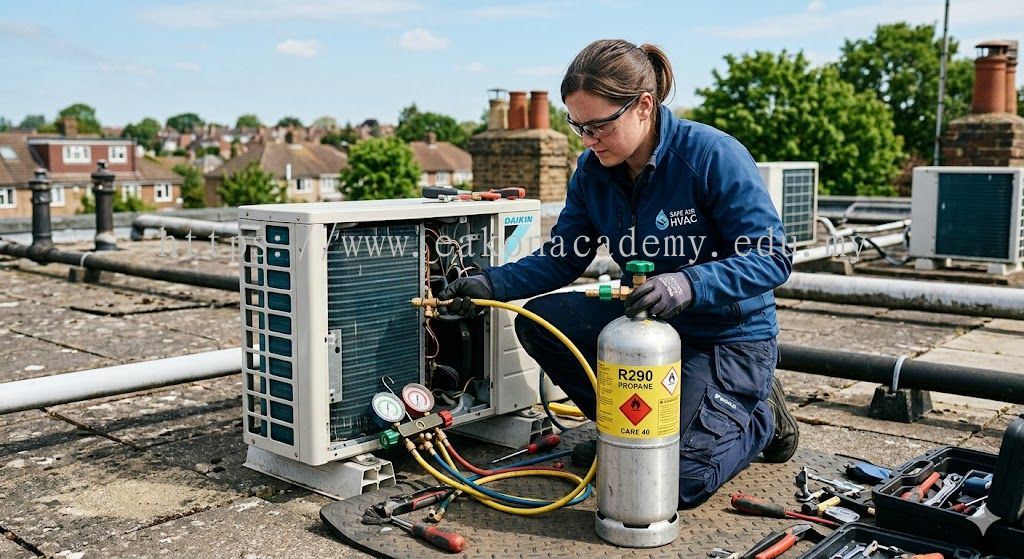
R290 CYLINDER HANDLING DURING SERVICING FOR SAFE HVAC-R OPERATIONS, LEAK PREVENTION, AND PROFESSIONAL REFRIGERANT SAFETY PRACTICES
R290 cylinder handling during servicing is a critical aspect of HVAC-R safety management that ensures the safe use, transport, connection, and storage of propane (R290) refrigerant cylinders during maintenance and repair operations. As the HVAC industry increasingly adopts environmentally friendly refrigerants with low global warming potential (GWP), R290 has become a widely used solution due to its high energy efficiency, excellent cooling performance, and minimal environmental impact. However, because R290 is classified as a flammable refrigerant, strict handling procedures must be followed during servicing to prevent fire hazards, gas leaks, and operational accidents. At eakonacadem.edu.my, we provide professional HVAC education and technical training that supports the correct understanding and application of R290 cylinder handling during servicing for industry professionals.
Proper R290 cylinder handling during servicing begins with safe transportation and positioning of refrigerant cylinders. Cylinders must always be transported in an upright position and secured to prevent tipping, rolling, or physical impact. Any damage to the cylinder can lead to leaks or pressure failure, increasing the risk of flammable gas release. Technicians must ensure that cylinders are handled carefully using approved lifting equipment or trolleys designed for refrigerant transport.
Another essential aspect of R290 cylinder handling is correct storage before and after servicing operations. Cylinders must be stored in well-ventilated areas away from direct sunlight, heat sources, electrical equipment, or ignition sources. Proper storage conditions help maintain cylinder integrity and reduce the risk of pressure buildup or accidental ignition. Clear labeling and separation of refrigerant types are also required to prevent misuse or incorrect handling.
During servicing, correct connection procedures are critical when attaching R290 cylinders to HVAC systems or recovery equipment. Technicians must ensure that all valves, hoses, and fittings are properly secured and leak-free before opening the cylinder. Only tools and equipment that are specifically designed and approved for hydrocarbon refrigerants should be used. This reduces the risk of leaks and ensures safe refrigerant transfer during maintenance operations.
Leak prevention is a major focus of R290 cylinder handling during servicing. Even small leaks can create flammable environments if exposed to ignition sources. Technicians must perform leak checks using approved detection methods before and after connecting cylinders. Proper sealing techniques and regular inspection of hoses and fittings are essential to maintaining system safety.
Ventilation is another key requirement when handling R290 cylinders during servicing. Adequate airflow must be maintained in the working area to prevent the accumulation of flammable gas in case of leakage. Proper ventilation ensures that any released refrigerant is quickly dispersed, reducing safety risks and maintaining safe working conditions.
Electrical safety is also an important consideration during cylinder handling. All nearby electrical equipment must be properly isolated or switched off when connecting or disconnecting R290 cylinders. This prevents accidental sparks that could ignite flammable refrigerant gas. Safe electrical practices are essential for ensuring a controlled servicing environment.
Emergency response preparedness is another important component of R290 cylinder handling procedures. Technicians must be trained to respond quickly and effectively in the event of leaks, cylinder damage, or accidental release. Proper emergency procedures help minimize risks and protect both personnel and equipment.
Regular inspection and maintenance of cylinders and associated equipment are also essential. Technicians must ensure that cylinders are free from corrosion, dents, or valve damage before use. Routine inspection helps maintain safety and ensures compliance with industry standards.
At eakonacadem.edu.my, we emphasize the importance of professional HVAC education related to R290 cylinder handling during servicing. Through structured training programs and practical hands-on learning, technicians gain the skills and knowledge required to safely manage hydrocarbon refrigerant cylinders in real-world HVAC applications.
Furthermore, proper cylinder handling practices support environmental sustainability by preventing refrigerant leaks and reducing greenhouse gas emissions. Safe handling ensures that R290 is used efficiently and responsibly in modern HVAC systems.
In conclusion, R290 cylinder handling during servicing is essential for ensuring safe, efficient, and compliant HVAC-R operations. By following proper procedures for transportation, storage, connection, leak prevention, ventilation, electrical safety, and emergency response, HVAC professionals can significantly reduce risks while improving system safety. This comprehensive approach strengthens HVAC education and makes it a key focus area for training platforms like eakonacadem.edu.my.
更多 EAKON ACADEMY SDN BHD 相关资料 Malaysia