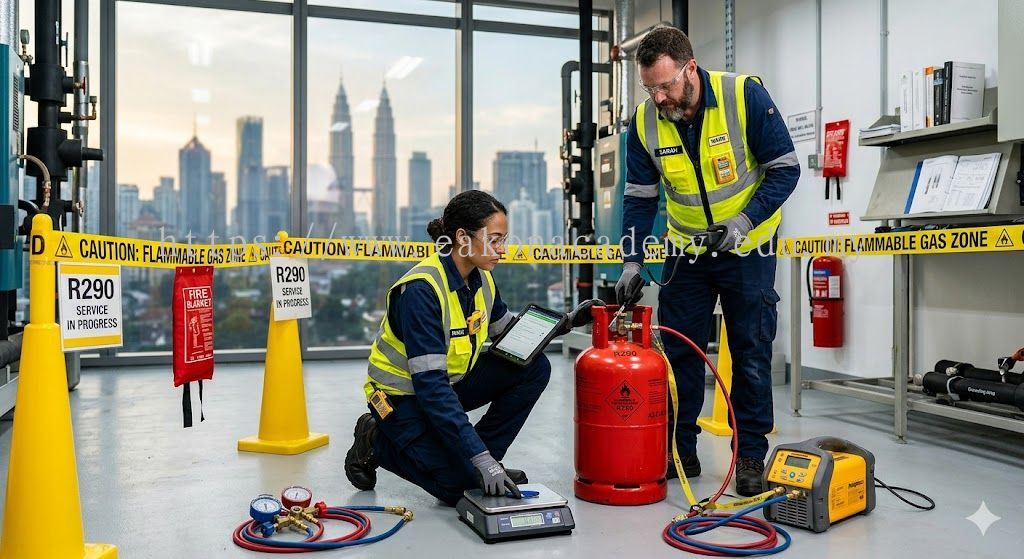
R290 CYLINDER HANDLING DURING MAINTENANCE: SAFE PRACTICES, INDUSTRIAL PROCEDURES AND PROFESSIONAL HVAC-R TRAINING FOR NATURAL REFRIGERANT SYSTEMS
R290 cylinder handling during maintenance is a critical safety and technical discipline in modern HVAC-R systems, especially as propane (R290) continues to be widely adopted as an eco-friendly, low global warming potential refrigerant in commercial and industrial refrigeration applications. Because R290 is classified as a flammable hydrocarbon refrigerant, proper cylinder handling procedures are essential to ensure technician safety, prevent fire hazards, and maintain system integrity during installation, servicing, recovery, and maintenance operations. Correct handling begins with proper storage and transportation of R290 cylinders, ensuring they are kept in well-ventilated areas away from heat sources, direct sunlight, sparks, or open flames. Cylinders must always be stored in an upright position, securely fastened to prevent tipping, and clearly labeled according to safety regulations. During maintenance operations, technicians must inspect cylinders for damage, corrosion, or valve leakage before use, as even minor defects can pose significant safety risks when dealing with flammable refrigerants.
A fundamental aspect of R290 cylinder handling during maintenance involves controlled refrigerant transfer and recovery procedures. Technicians must use approved recovery machines and charging equipment specifically designed for hydrocarbon refrigerants to prevent accidental leakage or ignition. Before connecting a cylinder to any HVAC system, pressure compatibility checks and hose integrity inspections must be performed to ensure safe operation. Proper grounding and bonding techniques are also required to eliminate static electricity buildup during refrigerant transfer, which is a critical safety measure when handling flammable gases. In addition, ventilation plays a key role in maintenance environments, as adequate airflow helps disperse any accidental refrigerant release and reduces the risk of vapor accumulation. Technicians must always follow strict gas concentration limits and safety protocols in confined or indoor spaces.
From a professional HVAC-R maintenance perspective, R290 cylinder handling procedures are closely linked to system efficiency, environmental protection, and regulatory compliance. Improper handling can lead to refrigerant loss, system contamination, and potential safety incidents, all of which negatively impact both operational performance and environmental sustainability. Therefore, technicians must be trained to handle cylinders with precision, using correct charging weights, pressure monitoring tools, and leak detection equipment. The use of personal protective equipment (PPE) such as safety gloves, goggles, and anti-static footwear is mandatory during all stages of cylinder handling to minimize exposure risks. These procedures are especially important in commercial refrigeration environments such as supermarkets, cold storage facilities, food processing plants, and industrial cooling systems where R290 systems are commonly used.
Educational and technical training institutions such as Eakon Academy Malaysia play an important role in developing skilled HVAC-R professionals who are capable of safely managing R290 cylinder handling during maintenance activities. Through structured training programs, learners gain practical experience in safe refrigerant handling, system servicing, leak prevention techniques, and compliance with Department of Environment (DOE) guidelines and international safety standards. This ensures that technicians are not only technically competent but also fully aware of the safety risks associated with hydrocarbon refrigerants and are able to apply industry best practices in real-world scenarios.
Furthermore, proper R290 cylinder handling during maintenance contributes significantly to sustainability and energy efficiency goals. By minimizing refrigerant loss and ensuring accurate charging procedures, systems operate more efficiently with reduced environmental impact and lower operational costs. As the HVAC-R industry continues to transition toward natural refrigerants and low-GWP technologies, the demand for skilled technicians trained in safe cylinder handling practices is increasing rapidly. Mastery of these procedures enhances career opportunities for technicians while supporting businesses in achieving safer, more efficient, and environmentally responsible refrigeration system operations.
更多 EAKON ACADEMY SDN BHD 相关资料 Malaysia