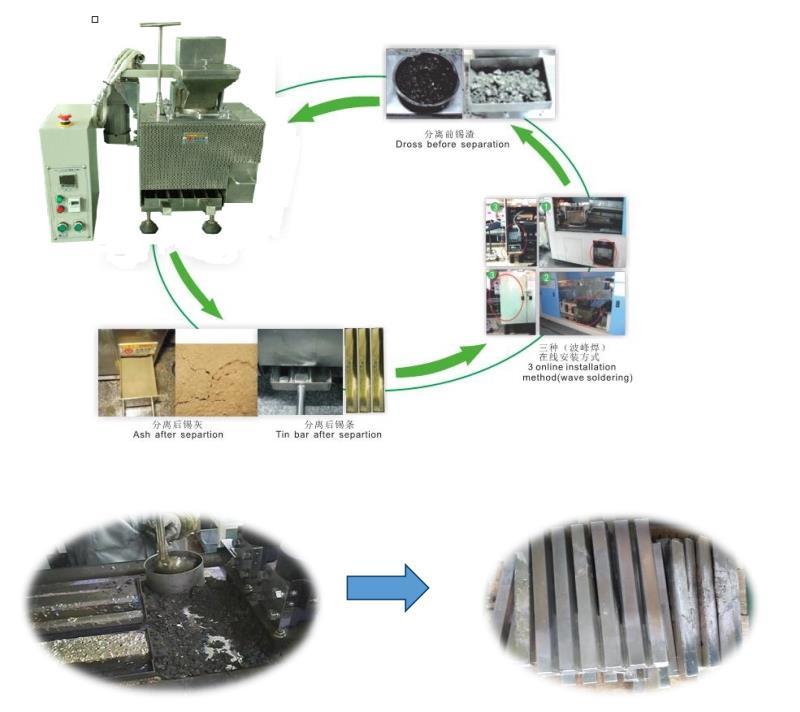
The Anewbest Solder Dross Separator is a high-efficiency recovery system designed to reclaim pure solder from the oxides (dross) generated during wave soldering. Using advanced physical separation methods, our equipment restores solder to a purity level of up to 93.6%, allowing the reclaimed alloy to be returned directly to the production line.
High Purity Output: Reclaimed solder maintains the integrity required for immediate manufacturing reuse.
Significant Cost Savings: Reduce your new solder purchases by up to 90% by reclaiming "waste" material.
Eco-Friendly Operations: Minimize industrial waste and reduce your facility's environmental footprint by avoiding heavy metal disposal.
Automated Efficiency: Process several tons of dross per hour with staged separation techniques and minimal operator intervention.
Our recovery machines utilize mechanical impact and high-precision separation to extract valuable metal alloys trapped within the dross layer.
Crushing & Liberation: Dross is fed into a high-torque crusher to reduce particle size and liberate trapped metal.
Multi-Stage Sorting: The crushed material passes through screening and density separation to isolate metallic particles from non-metallic oxides.
Advanced Extraction: Using high-intensity magnetic fields and eddy currents, the system separates ferrous and non-ferrous metals.
Collection: The purified metal is collected for immediate re-melting, while the remaining waste is reduced to a fraction of its original volume.
As a leading manufacturer in China, Shenzhen Anewbest Electronic Technology Co., Ltd. provides industrial-grade solutions tailored for modern foundries and SMT lines.
| Feature | Performance Capability |
| Recovery Rate | Up to 95% of trapped metals |
| Solder Purity | Up to 93.6% |
| Automation | Full-system automation available |
| Compatibility | Lead-free (SAC305) and Leaded alloys |
| Application | Wave soldering, Zinc/Aluminum smelting, and foundries |
Application
Electronic Manufacturing ..

1. Low temperature separation: Heating to 280℃ and then separating pure tin from dross.;
2.Pure physical: No need to add chemicals; mechanical separation; no pollution to solder and no change in solder quality and quantity;
3, Wet separation: Using solder to melt tin dross; no secondary oxidation, static separation, effectively reduce smoke pollution;
4, Tin dross recycling can reduce the waste of 75% tin dross, 90% resources can be recycled.
 Malaysia