
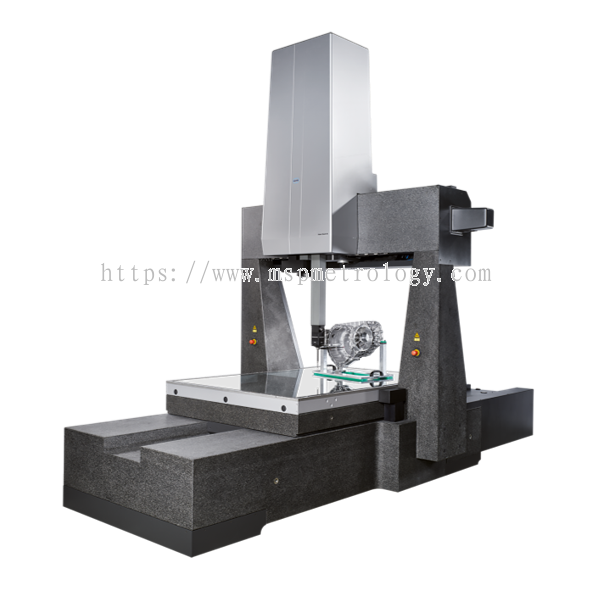
Werth Multisensor Tactile Coordinate Measuring Machine ProbeCheck Series

Werth Multisensor Tactile Coordinate Measuring Machine ProbeCheck Series

Kategori: Optical Measuring Machine Tersedia
Boleh Dibeli di Laman Web Rasmi
Untuk maklumat lanjut, lawati laman web rasmi kami di mspmetrology.com

Penerangan

ProbeCheck

Tactile Measurement in Production Control and Laboratory

Highly accurate tactile CNC metrology for shopfloor and measuring room – The coordinate measuring machine with fixed bridge enables fully automatic capture of three-dimensional geometries. According to requirements, measuring or switching tactile sensors can be used. Areas of application are, for example, larger cubic workpieces from toolmaking, mechanical engineering and the automotive industry.

Features

Highly Accurate Measurement

Highly accurate tactile coordinate measuring machine for fully automatic measurement of three-dimensional components.

Modular System Structure

The modular system structure provides customized solutions and can also be upgraded to cover future demands.

Probing Systems

Dynamic and touch-trigger probing systems are available according to the application.

Multisensor Flexibility

Integration of additional sensors to form a multisensor system and thus increased flexibility in solving measurement tasks.

WinWerth® 3D Software

WinWerth® 3D measuring software for measurement of standard geometries or for measurement compared with 3D CAD data.

Fast CNC Control

Fast CNC continuous-path control.

Multisensor Measuring Solutions

Production monitoring or laboratory, small or large workpieces, optical sensors, multi-sensor systems – Werth offers the right video measuring machine. Consistent quality assurance and acceptance tests according to VDI 2617 or ISO 10360 guarantee the reliability and accuracy of the machines. Task-specific measurement errors can be reduced down to the sub-micrometre range. Competent advice based on decades of experience enables customised combinations for optimal adaptation to the respective measuring task.

Typical Applications of Different Sensor

a) Conventional probes

b) Werth Fiber Probe®

c) Laser

d) Image processing

e) Autofocus

f) Werth 3D-Patch

g) 3D Werth Fiber Probe

h) X-ray Tomography Sensor

Telecentric for Constant Image Scale

Non-telecentric images change sharpness and image scale as the object distance changes. With telecentric imaging on the object side (right), in contrast, the images have nearly constant scale.

a) Sensor plane
b) Virtual image plane
c) Telecentric diaphragm

Contour Image Processing for Reliable Measurement

In contour image processing, the image is viewed as a two-dimensional whole within an evaluation window. Contours are extracted from this image using suitable mathematical algorithms (operators). Each image point of a contour corresponds to a measurement point. The measurement points are strung together like a string of pearls. This makes it possible to detect and filter out interfering contours caused by surface structures, breakouts and dirt during measurement (contour filters) without changing the mould of the contours.

Patented Werth MultiRing®

The advantage of Patented Werth MultiRing:

  • Angle of incidence selectable
  • No loss of working distance
  • No mechanically moving parts
  • Large angle range adjustable
  • White high power LEDs

Werth Autofocus Sensor

By combining the non-contact measuring methods of image processing and autofocus sensor, many three-dimensional measuring tasks can be solved. The features of Werth Autofocus:

  • Integrated in Werth Zoom
  • Measuring on low-contrast surfaces
  • Standard configuration for highest magnification
  • Selection via sensor button
  • Also usable with 3D patch

Werth FlatLight®

Minimizing out of focus condition with a special illumination device with a small numerical aperture.  Even high and rounded profile sections can be measured with great precision.

WinWerth® Software

The operation of machines with a wide variety of sensors, but also the evaluation of volume data and point clouds are possible with WinWerth® in a unique combination. The Werth image processing software is based on 40 years of experience and is the foundation of probably the most powerful image processing sensors for coordinate measuring machines currently available. Optical distance sensors, conventional styluses in single-point or scanning mode, the Werth Fiber Probe®, X-ray computed tomography or machines with a combination of several sensors are all supported by the uniform concept. Measurement points, 2D images or volume data can also be conveniently evaluated in terms of geometrical characteristics or with part-to-part deviation analysis. PTB-certified evaluation algorithms ensure correct measurement results. All desired information is displayed in the graphic: CAD models with PMI data, voxel volumes, measurement point clouds, colour-coded deviation plots from 3D nominal-actual comparisons, video images, measurement and calculation elements as well as flags with nominal and actual values, tolerances and deviations. In order to meet the most diverse requirements, the software has a modular structure. Various machines can be operated, from simple measuring projectors to complex multi-axis coordinate measuring machines with multi-sensor systems or even X-ray tomography sensors.

Image Processing Measures almost by Itself

The “intelligence” of the WinWerth® measurement software then takes over, for example, the exact determination of the object area to be captured and the selection of the geometrical element to be measured.

Measurement Points Distributed Automatically

Measurement points or scan lines are automatically distributed on the geometry elements to be measured, taking into account the necessary travel paths.

Evaluating Images Perfectly

The evaluation is mainly realised by PC hardware and software. In a first processing step, the image can be improved with image filters.

Testing and Changing Made Easy

The feature tree in the WinWerth® user interface also controls the test and change mode, in which programmes can be run step-by-step and changes can be added.

CAD-Online® and CAD-Offline®

Measurement programs can be generated both online and offline using 2D or 3D CAD models.

Volume Section Sensor

With 2D contour image processing and the associated image processing filters, measurements can also be taken in any cross section of the CT volume or point cloud.

Eccentric Sections can be Scanned Tomographically with Multi-ROI CT

With the help of section tomography or ROI tomography (ROI: Region of Interest), parts of the measuring object are measured with high resolution without having to capture the entire measuring object, e.g. , completely with high resolution using Raster Tomography, which is time-consuming and requires a lot of memory. Multi-ROI tomography offers a combination of the benefits of eccentric and sectional tomography scans. Multiple parts with high resolution can also be selected at any position in the measuring object.

Automatic Burr Detection

A special feature of Werth is the automatic detection and measurement of burrs or chips during the measurement sequence. The result is a colour-coded deviation plot of the burr and the maximum burr length. The deviation display optionally shows only those points where the burr length exceeds the tolerance limits. The burr length along the entire burr can also be displayed numerically via analysis markers. For example, every 0.5 mm a flag is set that contains the maximum local burr length.

Graphic Displays and Reports

WinWerth® displays all the measured elements along with the selected geometrical characteristics in the 2D or 3D graphics window. The report generator summarizes the various outputs in “Office style.

All desired dimensions are collected during measurement, statistically analyzed in real time and evaluated using standard SPC functions.

Test Report

Full Specifications

Specification ProbeCheck
Operating Temperature 10 – 35 °C (50 – 95 °F)
Application Tactile Measurement in Production Control and Laboratory
Software WinWerth® 3D measuring software

** Other supply data on request or according to specific countrykit

ProbeCheck Basic

Maximum Permissible Error MPE (extract)
For advanced laboratory conditions
Tactile sensor E: (1.5 + L/300) µm    
PS/PF: 1.5 µm THN: 5 µm THP: 5 µm

ProbeCheck

Maximum Permissible Length Measurement or Probing Error MPE (extract)
For advanced laboratory conditions
Tactile sensor ¹ ~ ² ~ E: (1.5 + L/300) µm    
PS/PF: 1.5 µm THN: 5 µm THP: 5 µm

ProbeCheck HA

Maximum Permissible Error MPE (extract)
For advanced laboratory conditions
Tactile sensor ¹ ~ ² ~ E: (0.5 + L/600) µm    
PS/PF: 0.6 µm THN: 1.5 µm THP: 1.5 µm
 
For standard laboratory condition
Tactile sensor ¹ ~ ³ ~ E: (0.5 + L/350) µm    
PS/PF: 0.6 µm THN: 1.5 µm THP: 1.5 µm

(Where L = measuring length in mm comparable to ISO 10360 and VDI/VDE 2617)

1) Measured with TP200 or SP25 Kit 1 probe (stylus length 20 mm, sphere diameter 2 mm) or with a probe with the same or better probing error

2) ∂ = 20 °C ± 1 K                ∇∂ = 0.5 K/h, 0.5 K/m                m ≤ 150 kg

3) ∂ = 20 °C ± 2 K                ∇∂ = 1 K/h                                   m ≤ 150 kg

4) ∂ = 16 °C to 30 °C           ∇∂ = 2 K/h, 2 K/m                      m ≤ 150 kg

Contact us today to inquire about ProbeCheck and enhance your tactile measurement capabilities.

Lebih maklumat tentang MSP Metrology (M) Sdn Bhd
MSP Metrology (M) Sdn Bhd
MSP Metrology (M) Sdn Bhd Precision Measuring Equipment Supplier in Malaysia & Singapore | Metrology & Material Testing Supply JB, KL & Penang - MSP Metrology (M) Sdn Bhd