
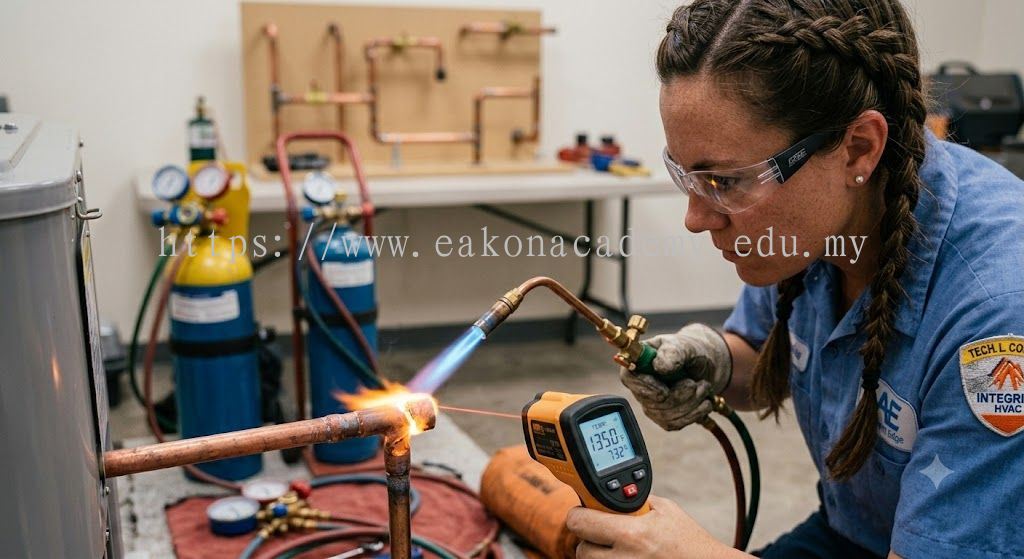
Air Conditioning Brazing Temperature Control – Precise HVAC Copper Pipe Heating Technique for Strong and Leak-Free Joints
The air conditioning brazing temperature control process is one of the most important technical skills in HVAC and refrigeration installation, ensuring that copper pipe joints are properly heated to achieve strong, durable, and leak-free connections. In air conditioning systems, incorrect temperature control during brazing can lead to weak joints, refrigerant leakage, internal oxidation, or even complete system failure. Therefore, mastering accurate heat management is essential for every HVAC technician. At Eakon Academy, temperature control techniques are a core part of practical HVAC training, helping learners develop the precision required for professional-level installation work.
The air conditioning brazing temperature control process begins with understanding the correct temperature range required for copper brazing. Typically, HVAC brazing is performed at temperatures between 600°C and 650°C, depending on the type of filler rod used. Reaching this temperature range is critical because it allows the brazing alloy to melt properly and flow through capillary action without melting the base copper material. If the temperature is too low, the filler metal will not bond properly, resulting in weak joints. If the temperature is too high, the copper pipe may become damaged or oxidized, compromising system integrity.
Proper flame adjustment is a key part of effective temperature control. Technicians must use an oxy-acetylene torch with a correctly set neutral flame, which provides balanced combustion for even heating. An oxidizing flame can damage the copper surface, while a carburizing flame can create soot and contamination. Maintaining a stable neutral flame ensures that heat is applied evenly and consistently across the joint area, which is essential for achieving uniform brazing quality.
Another important aspect of the air conditioning brazing temperature control technique is heat distribution management. Technicians must avoid concentrating heat in one area for too long, as this can cause localized overheating and weaken the pipe structure. Instead, the flame should be moved in a circular motion around the joint to ensure even heating. Skilled technicians also observe the copper color change as a visual indicator of temperature progression, which helps determine the exact moment when brazing filler rod should be applied.
Nitrogen purging also plays a supportive role in temperature-controlled brazing. By introducing a controlled flow of nitrogen inside the pipe during heating, internal oxidation is prevented even at high temperatures. This ensures that the inside of the copper pipe remains clean and free from scale formation, which is essential for maintaining long-term refrigeration efficiency and preventing blockages.
Once the correct temperature is achieved, the brazing filler rod is applied carefully. It is important that the rod is melted by the heat of the copper pipe rather than direct flame contact. This ensures proper capillary action, allowing the molten filler to fully penetrate the joint and create a strong, leak-proof seal. Maintaining temperature stability during this stage is critical for joint quality and durability.
After brazing, controlled cooling is equally important. The joint must be allowed to cool naturally without the use of water or forced air, as sudden temperature changes can create thermal stress and weaken the joint. Proper cooling ensures that the brazed connection remains strong and stable over time.
In conclusion, the air conditioning brazing temperature control process is essential for achieving high-quality HVAC installations that are safe, efficient, and long-lasting. Through structured training and hands-on practice at Eakon Academy, students gain the technical knowledge and practical experience needed to master precise heat control techniques, ensuring professional-grade copper brazing results that meet modern industry standards.
Lebih maklumat tentang EAKON ACADEMY SDN BHD Malaysia
