
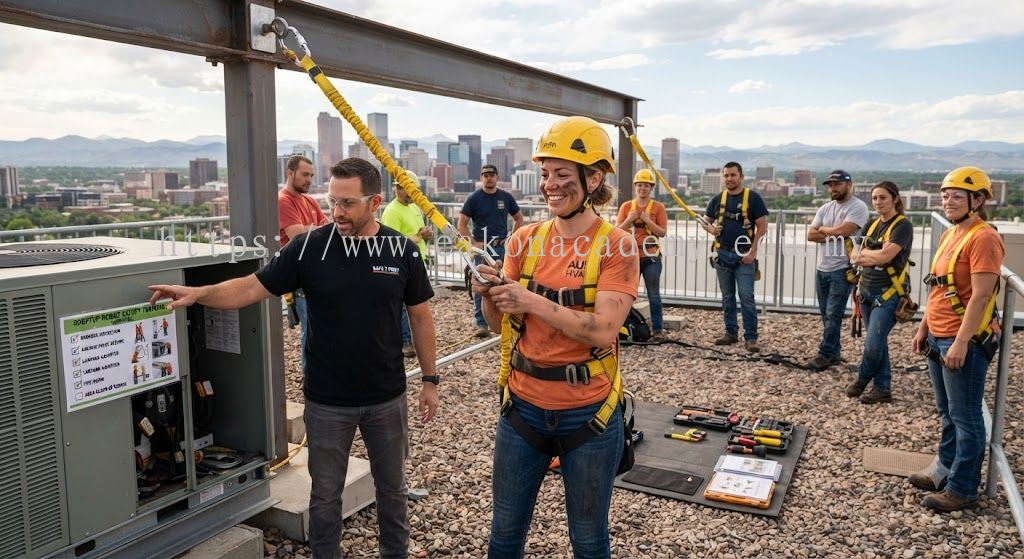
HVAC Contractor Height Safety Training Requirements: Essential Working at Height Training for Professional HVAC Technicians
HVAC contractor height safety training requirements are a fundamental part of creating a safe, compliant, and highly skilled workforce within the heating, ventilation, air conditioning, and refrigeration (HVACR) industry. HVAC technicians regularly perform installation, servicing, maintenance, inspection, troubleshooting, and repair work on rooftops, elevated platforms, ladders, scaffolding, mechanical plant rooms, cooling towers, ceiling spaces, and high-rise buildings. These work environments expose contractors to significant hazards, including falls from height, unstable working surfaces, electrical risks, falling tools, adverse weather conditions, and manual handling injuries. Comprehensive height safety training equips technicians with the knowledge, practical skills, and confidence needed to recognize hazards, implement preventive measures, and comply with workplace safety regulations. At Eakon Academy (eakonacadem.edu.my), we offer industry-focused HVAC height safety training programs that combine classroom learning with practical hands-on exercises, helping contractors, supervisors, and technicians develop the competency required to perform work at height safely while meeting occupational safety and health standards.
One of the primary height safety training requirements for HVAC contractors is understanding hazard identification and risk assessment. Before beginning any work at height, technicians should be trained to inspect the worksite for potential hazards such as unprotected roof edges, fragile roofing materials, unstable ladders, slippery walking surfaces, overhead electrical power lines, confined access routes, falling object hazards, and changing weather conditions. A thorough risk assessment enables workers to identify potential dangers before work begins and implement suitable control measures to eliminate or minimize risks. Training should also cover the preparation and interpretation of Safe Work Method Statements (SWMS), Job Safety Analysis (JSA), and permit-to-work systems that support safe and systematic work planning.
Understanding the hierarchy of hazard controls is another essential component of HVAC contractor height safety training. Workers should learn that the safest approach is always to eliminate the need to work at height whenever possible. If elimination cannot be achieved, engineering controls such as guardrails, roof edge protection systems, safety barriers, and permanent access platforms should be implemented before relying on personal protective equipment. Administrative controls, including safe work procedures, supervision, signage, and work permits, provide additional protection. Personal fall protection systems should only be used when other control measures cannot fully eliminate fall hazards. Training technicians to apply the hierarchy of controls promotes proactive hazard management and improves overall workplace safety performance.
Fall protection equipment training is one of the most important requirements for HVAC technicians working at height. Contractors should receive practical instruction on the correct selection, inspection, fitting, adjustment, and use of full-body safety harnesses, shock-absorbing lanyards, self-retracting lifelines (SRLs), horizontal lifeline systems, rope grabs, connectors, and certified anchor points. Workers should understand fall clearance calculations, swing fall hazards, anchor point selection, and proper connection methods to ensure fall protection systems perform effectively during an emergency. Regular equipment inspection should also be emphasized, including identifying damaged webbing, worn stitching, defective connectors, corrosion, and signs of previous fall loading. Proper knowledge of fall protection equipment significantly reduces the likelihood of injuries caused by falls from height.
Safe ladder usage forms another key element of height safety training requirements. HVAC contractors frequently use extension ladders and step ladders to access outdoor condensing units, rooftop equipment, ceiling-mounted systems, and elevated service locations. Training should include correct ladder selection, inspection procedures, positioning techniques, securing methods, maintaining three points of contact, safe climbing practices, and recognizing situations where ladders are no longer the safest option. Technicians should also understand when alternative access equipment such as scaffolding, boom lifts, scissor lifts, or other mobile elevated work platforms (MEWPs) provides a safer solution for extended work durations or complex maintenance activities.
Training should also cover the safe operation of elevated work platforms commonly used in the HVAC industry. Boom lifts, scissor lifts, cherry pickers, and other MEWPs require specialized knowledge regarding machine controls, stability principles, platform load capacities, emergency lowering systems, safe driving techniques, hazard awareness, and operator responsibilities. HVAC contractors should only operate elevated work platforms after receiving formal competency-based instruction and practical assessments. Understanding equipment limitations and safe operating procedures significantly improves productivity while minimizing the risk of equipment-related accidents.
Electrical safety is another essential subject within HVAC height safety training programs. Air conditioning technicians often work near energized electrical systems, distribution boards, rooftop condensers, compressors, control panels, and outdoor power supplies. Training should include lockout and tagout procedures, electrical isolation methods, voltage verification, insulated tool usage, grounding principles, and safe working distances from overhead power lines. Proper electrical safety awareness helps prevent electric shock, arc flash incidents, equipment damage, and fire hazards during elevated HVAC operations.
Weather awareness is equally important when working at height. HVAC contractors should understand how environmental conditions such as heavy rain, lightning, high winds, excessive heat, and poor visibility affect workplace safety. Rooftop surfaces become slippery during wet conditions, while strong winds can reduce worker stability and affect the safe operation of elevated work platforms. Height safety training should emphasize stop-work procedures, weather monitoring responsibilities, and safe evacuation practices whenever conditions become hazardous. Understanding weather-related risks enables technicians to make informed decisions that prioritize safety over productivity.
Emergency preparedness and rescue procedures should be integrated into every HVAC contractor height safety training program. Workers should understand how to respond to falls, suspended workers, electrical emergencies, refrigerant leaks, fire incidents, medical emergencies, and severe weather evacuations. Training should include emergency communication methods, rescue equipment usage, first aid awareness, suspension trauma prevention, and coordination with emergency services. Practical rescue exercises improve worker confidence while ensuring technicians can respond quickly and effectively during unexpected incidents.
Good housekeeping and material handling are also important aspects of working safely at height. HVAC technicians should learn to organize tools, refrigerant hoses, electrical cables, copper piping, spare components, and packaging materials to eliminate trip hazards. Heavy equipment such as compressors, outdoor units, and refrigerant cylinders should be transported using mechanical lifting equipment whenever practical to reduce manual handling injuries. Tool lanyards should be used where appropriate to prevent falling objects that could injure workers below. Clean and organized work areas improve both safety and operational efficiency.
At Eakon Academy (eakonacadem.edu.my), we are committed to producing highly competent HVAC professionals through practical, industry-relevant training programs that combine technical excellence with comprehensive workplace safety education. Our HVAC height safety training courses cover risk assessment, fall protection systems, rooftop safety, ladder safety, elevated work platform operation, PPE inspection, electrical safety, emergency response, regulatory compliance, and safe work practices to prepare technicians for real-world challenges. By meeting HVAC contractor height safety training requirements, companies can reduce workplace accidents, strengthen legal compliance, improve employee competency, increase customer confidence, and establish a reputation for delivering safe, reliable, and professional HVAC services. Investing in comprehensive height safety training is not only a regulatory obligation but also a strategic investment in employee wellbeing, operational excellence, business sustainability, and long-term success within the competitive HVAC and refrigeration industry.
Lebih maklumat tentang EAKON ACADEMY SDN BHD Malaysia
