
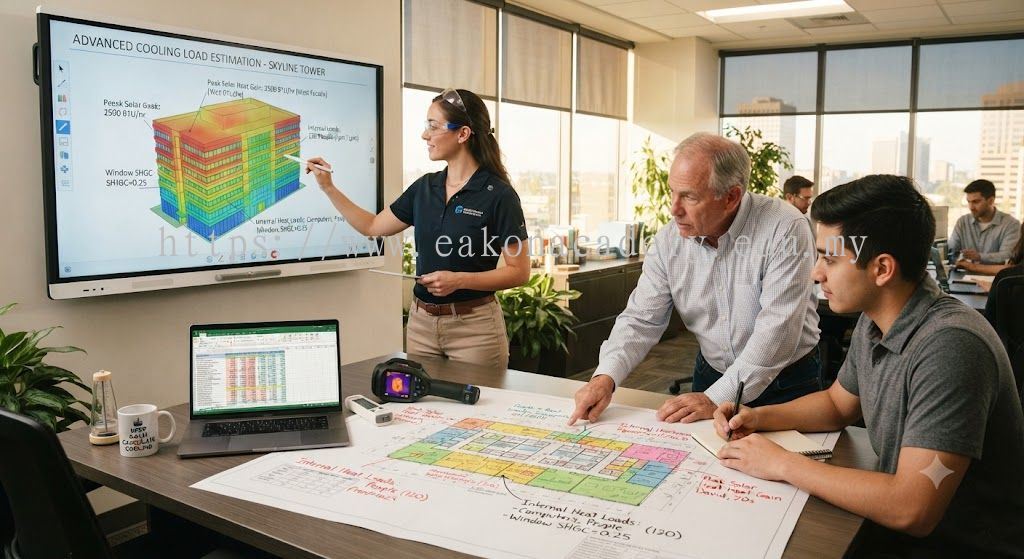
Advanced Cooling Load Estimation Techniques AC: Enhancing HVAC System Performance Through Accurate Engineering Calculations
Advanced cooling load estimation techniques for AC systems are essential for designing high-performance, energy-efficient, and reliable air conditioning systems. As buildings become more complex and energy regulations become stricter, HVAC professionals must move beyond simple rule-of-thumb calculations and adopt advanced engineering methods that deliver greater accuracy and improved system performance. Cooling load estimation is the process of determining the total amount of heat that must be removed from an indoor space to maintain comfortable temperature and humidity levels. By applying advanced cooling load estimation techniques, engineers and technicians can optimize equipment selection, reduce operating costs, improve indoor comfort, and increase the overall efficiency of residential, commercial, and industrial air conditioning systems. At Eakon Academy (eakonacadem.edu.my), HVAC professionals, engineers, consultants, contractors, and students receive comprehensive training on advanced cooling load estimation methods that follow international standards and current industry best practices.
Cooling load estimation involves evaluating every source of heat entering a building. External heat gains include solar radiation through windows, heat transfer through roofs, walls, and floors, outdoor air infiltration, and ventilation. Internal heat gains originate from occupants, lighting systems, office equipment, machinery, electrical appliances, computers, and other heat-producing devices. Advanced estimation techniques analyze these variables in greater detail, allowing HVAC designers to calculate both sensible and latent cooling loads with high precision. Accurate calculations ensure that air conditioning systems provide stable indoor temperatures, effective humidity control, and optimal energy efficiency throughout the building's operating life.
Modern HVAC engineering relies on several advanced cooling load estimation methods. Among the most widely accepted are the Cooling Load Temperature Difference (CLTD) method, Cooling Load Factor (CLF), Radiant Time Series (RTS) method, Heat Balance (HB) method, Transfer Function Method (TFM), and ACCA Manual J calculations for residential buildings. These techniques evaluate numerous building characteristics, including orientation, construction materials, insulation quality, glazing performance, occupancy schedules, ventilation rates, lighting density, equipment heat output, and local climate conditions. Compared with simplified estimation methods, advanced calculations provide far more accurate cooling capacity requirements, helping engineers design HVAC systems that operate efficiently under real-world conditions.
One of the primary advantages of advanced cooling load estimation techniques is proper air conditioning equipment sizing. Oversized systems frequently cycle on and off, resulting in higher electricity consumption, poor humidity removal, increased maintenance, and reduced equipment lifespan. Undersized systems struggle to meet cooling demands, causing continuous operation, excessive compressor wear, and uncomfortable indoor environments. Advanced load calculations eliminate these problems by accurately matching cooling capacity to the building's actual thermal load, ensuring long-term performance, reliability, and occupant comfort.
In tropical countries such as Malaysia, advanced cooling load estimation is especially important due to consistently high outdoor temperatures, intense solar radiation, and elevated humidity levels. Buildings experience significant cooling demands throughout the year, making precise calculations essential for reducing energy consumption while maintaining comfortable indoor conditions. HVAC professionals must account for factors such as solar heat gain, roof insulation, window orientation, shading devices, occupancy density, fresh air ventilation requirements, and building usage patterns. These detailed assessments enable engineers to develop efficient HVAC systems capable of delivering reliable cooling even under challenging environmental conditions.
Advanced cooling load estimation also plays a critical role in sustainable building design and energy conservation. Green building certifications and energy-efficient construction standards require HVAC systems to be designed using scientifically validated engineering calculations rather than rough estimates. Accurate cooling load analysis minimizes unnecessary energy consumption, lowers carbon emissions, reduces equipment oversizing, and supports environmentally responsible building operation. Proper load estimation contributes to achieving higher energy performance ratings while helping organizations meet sustainability goals and regulatory requirements.
Today's HVAC industry increasingly utilizes advanced simulation software to perform detailed cooling load calculations. Programs such as Carrier HAP, Trane TRACE 3D Plus, EnergyPlus, IES VE, and other professional HVAC design software can analyze thousands of building variables to generate highly accurate cooling load reports. However, software is only as reliable as the engineer operating it. HVAC professionals must understand the engineering principles behind sensible heat, latent heat, psychrometrics, air infiltration, ventilation, heat transfer, occupancy factors, and thermal mass to validate software outputs and ensure accurate system designs. Strong technical knowledge remains the foundation of successful HVAC engineering.
At Eakon Academy, participants gain practical experience with advanced cooling load estimation techniques through hands-on workshops, engineering exercises, building simulations, and real-world project case studies. Students learn how to analyze building heat gains, perform comprehensive cooling load calculations, interpret architectural drawings, evaluate HVAC system performance, and select the most appropriate air conditioning equipment for residential, commercial, and industrial applications. The academy's industry-focused training bridges theoretical engineering concepts with practical field experience, preparing learners to meet the demands of today's HVAC industry with confidence and professionalism.
As energy efficiency, indoor environmental quality, and sustainable building practices continue to shape the future of the HVAC industry, expertise in advanced cooling load estimation techniques has become an invaluable professional skill. Engineers, consultants, contractors, technicians, and facility managers who understand advanced cooling load analysis can deliver more efficient HVAC solutions, reduce operating costs, improve occupant comfort, and enhance system reliability. By enrolling in professional HVAC training at Eakon Academy (eakonacadem.edu.my), learners can build advanced technical knowledge, strengthen their engineering capabilities, improve career opportunities, and contribute to the development of innovative, energy-efficient air conditioning systems that meet modern industry standards and future technological advancements.
Lebih maklumat tentang EAKON ACADEMY SDN BHD Malaysia
