
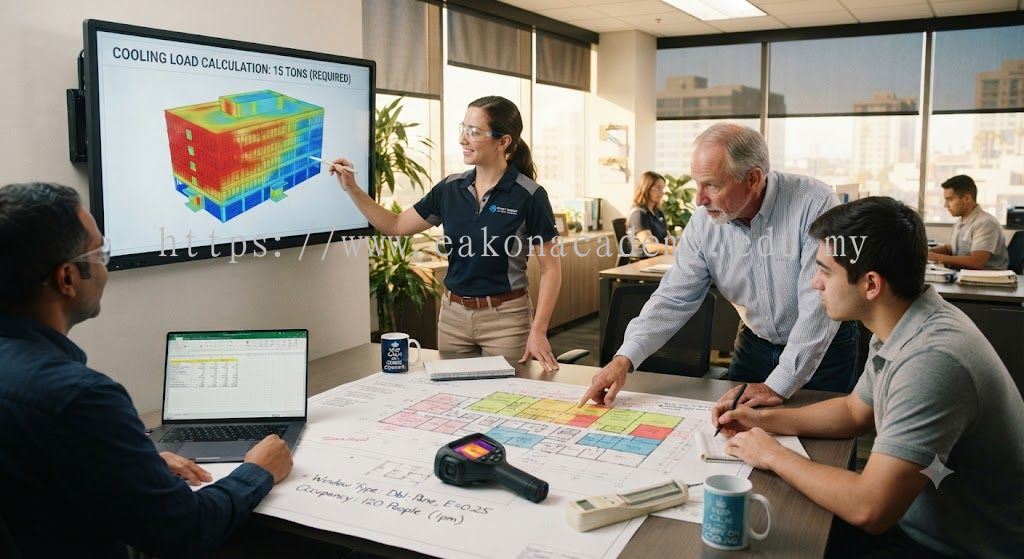
Air Conditioning Capacity Selection Cooling Load: A Complete Guide to Accurate HVAC System Sizing and Energy Efficiency
Selecting the correct air conditioning capacity based on cooling load is one of the most important steps in designing an efficient and reliable HVAC (Heating, Ventilation, and Air Conditioning) system. Proper air conditioning capacity selection ensures that an AC unit can effectively remove heat from an indoor environment while maintaining comfortable temperature and humidity levels. Whether for residential homes, commercial buildings, industrial facilities, retail spaces, hospitals, hotels, or educational institutions, cooling load calculations provide the engineering foundation for choosing the right air conditioning capacity. At Eakon Academy (eakonacadem.edu.my), HVAC technicians, engineers, consultants, contractors, and students are trained to perform professional cooling load calculations and accurately select air conditioning systems that maximize performance, energy efficiency, and long-term reliability.
Cooling load refers to the total amount of heat that an air conditioning system must remove from a building to maintain the desired indoor conditions. This load is measured in British Thermal Units per hour (BTU/hr), refrigeration tons (TR), or kilowatts (kW). Determining the correct cooling load requires evaluating numerous factors, including building size, room dimensions, ceiling height, insulation quality, window orientation, solar heat gain, outdoor climate conditions, occupancy levels, lighting systems, electrical equipment, appliances, ventilation requirements, and air infiltration. Every source of heat contributes to the overall cooling requirement, making accurate calculations essential before selecting any air conditioning equipment.
Proper air conditioning capacity selection begins with a detailed cooling load assessment rather than relying on room size alone. Many people mistakenly choose an air conditioner based solely on floor area, but professional HVAC design considers much more than square footage. Two rooms with identical dimensions may require completely different cooling capacities depending on insulation levels, window exposure, occupancy, lighting density, and internal heat-generating equipment. By calculating the actual cooling load, HVAC professionals ensure that every air conditioning system is correctly sized for its specific application.
Choosing the correct air conditioning capacity offers numerous advantages. A properly sized system operates efficiently, maintains stable indoor temperatures, controls humidity effectively, reduces electricity consumption, minimizes equipment wear, and provides greater occupant comfort. Correct capacity selection also improves airflow distribution, reduces compressor cycling, extends system lifespan, and lowers maintenance costs. Building owners benefit from reduced operating expenses while enjoying consistent cooling performance throughout the year.
Incorrect air conditioning capacity selection can significantly reduce HVAC system performance. An undersized air conditioning unit struggles to remove sufficient heat, resulting in continuous operation, excessive electricity usage, higher compressor stress, and uncomfortable indoor temperatures. On the other hand, an oversized unit cools the room too quickly without adequately removing moisture from the air. This frequent on-and-off cycling decreases energy efficiency, increases maintenance requirements, shortens equipment life, and creates uncomfortable humidity levels. Accurate cooling load calculations eliminate these issues by matching the system capacity precisely to the building's actual cooling requirements.
Professional HVAC engineers use internationally recognized cooling load calculation methods to determine the appropriate air conditioning capacity. Common engineering approaches include the Cooling Load Temperature Difference (CLTD) method, Cooling Load Factor (CLF), Radiant Time Series (RTS), Heat Balance (HB) method, Transfer Function Method (TFM), and ACCA Manual J calculations for residential buildings. These methods evaluate sensible heat gains, latent heat gains, ventilation loads, infiltration, occupancy schedules, lighting loads, equipment heat generation, and local weather conditions. The resulting calculations provide highly accurate data for selecting air conditioning equipment that delivers optimal performance and energy efficiency.
In Malaysia's tropical climate, air conditioning capacity selection becomes even more critical. High outdoor temperatures, intense solar radiation, and elevated humidity levels place greater demands on HVAC systems throughout the year. Buildings with large glass windows, poor insulation, rooftop exposure, or high occupant density experience significantly higher cooling loads than well-insulated structures. Accurate cooling load analysis allows HVAC professionals to select equipment capable of maintaining indoor comfort despite challenging environmental conditions while avoiding unnecessary energy consumption.
Modern HVAC design software has greatly improved the accuracy and efficiency of cooling load calculations. Professional applications such as Carrier HAP, Trane TRACE 3D Plus, EnergyPlus, and other engineering software can analyze building characteristics and calculate detailed cooling loads. However, successful HVAC design still depends on the engineer's understanding of heat transfer principles, psychrometrics, ventilation requirements, building construction, sensible heat, latent heat, and system performance. Software serves as a valuable design tool, but engineering knowledge remains essential for validating results and selecting the most suitable air conditioning capacity.
At Eakon Academy, participants receive comprehensive hands-on training in cooling load calculation and air conditioning capacity selection through practical workshops, engineering exercises, real-world case studies, and HVAC design simulations. Students learn how to analyze building heat gains, perform accurate cooling load calculations, interpret architectural drawings, evaluate system performance, and select air conditioning equipment for residential, commercial, and industrial applications. The academy combines classroom theory with practical field experience, equipping learners with the technical skills required to design efficient, reliable, and energy-saving HVAC systems that meet international engineering standards.
As energy efficiency, environmental sustainability, and indoor comfort become increasingly important across the construction and HVAC industries, expertise in air conditioning capacity selection based on cooling load has become a highly valuable professional skill. Accurate cooling load calculations help reduce energy consumption, improve HVAC performance, support green building initiatives, and extend equipment lifespan. By enrolling in professional HVAC training at Eakon Academy (eakonacadem.edu.my), technicians, engineers, consultants, and contractors can strengthen their knowledge of cooling load analysis, master advanced air conditioning system sizing techniques, enhance career opportunities, and contribute to delivering high-performance, energy-efficient HVAC solutions that meet the evolving demands of modern buildings and the global air conditioning industry.
Lebih maklumat tentang EAKON ACADEMY SDN BHD Malaysia
