
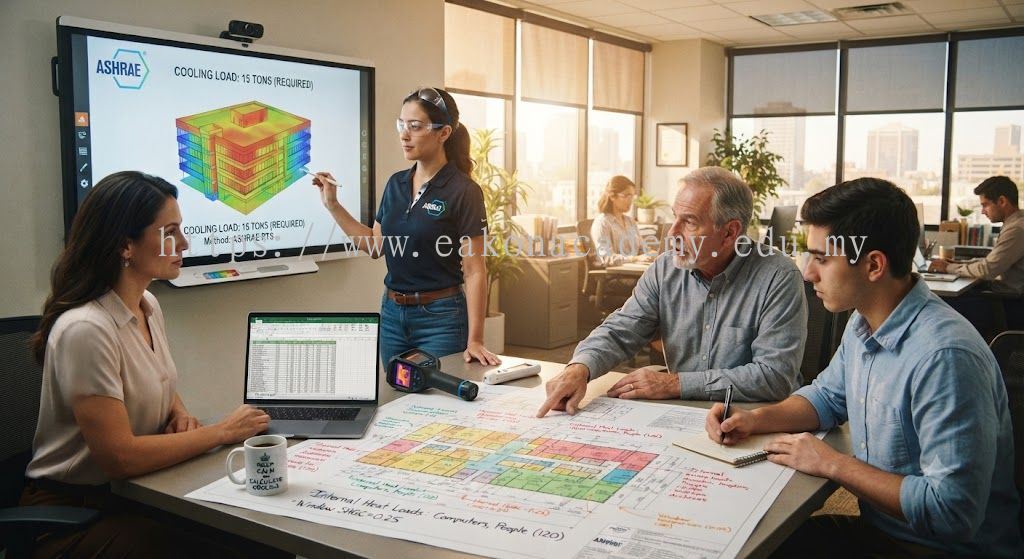
Air Conditioning Thermal Load Estimation Method: A Complete Guide to Accurate HVAC Cooling Load Analysis and Energy-Efficient System Design
The air conditioning thermal load estimation method is a fundamental engineering process used to determine the amount of heat that must be removed from a building to maintain comfortable indoor temperatures and humidity levels. Accurate thermal load estimation forms the backbone of every successful HVAC (Heating, Ventilation, and Air Conditioning) design because it ensures that air conditioning systems are correctly sized, energy-efficient, and capable of delivering reliable long-term performance. Whether designing HVAC systems for residential homes, commercial offices, hospitals, hotels, shopping centres, factories, educational institutions, or industrial facilities, understanding thermal load estimation methods is essential for achieving optimal indoor comfort while minimizing energy consumption. At Eakon Academy (eakonacadem.edu.my), HVAC technicians, engineers, consultants, contractors, and students receive comprehensive training in thermal load estimation, cooling load analysis, and modern HVAC design techniques that meet international engineering standards and industry best practices.
Thermal load estimation is the engineering process of calculating the total amount of heat entering a building from both external and internal sources. External heat gains include solar radiation through windows, conductive heat transfer through walls, roofs, ceilings, floors, and doors, as well as warm outdoor air entering through ventilation systems and air infiltration. Internal heat gains originate from occupants, lighting fixtures, office equipment, computers, electrical appliances, manufacturing equipment, and other heat-producing devices. HVAC engineers classify these heat gains into sensible heat, which increases air temperature, and latent heat, which increases moisture content in the indoor air. Both sensible and latent heat must be accurately calculated to determine the total cooling capacity required for an efficient air conditioning system.
An accurate air conditioning thermal load estimation method is critical because every building has unique thermal characteristics. Factors such as floor area, ceiling height, building orientation, insulation quality, wall construction, roofing materials, glazing type, occupancy density, lighting power, equipment operation, ventilation requirements, humidity levels, and local weather conditions all influence the overall thermal load. Two buildings of the same size can have significantly different cooling requirements depending on these variables. A professional thermal load estimation method evaluates each factor carefully, enabling HVAC engineers to select equipment that precisely matches the building's cooling demand.
One of the primary benefits of accurate thermal load estimation is proper air conditioning system sizing. When cooling equipment is selected using detailed engineering calculations, the HVAC system operates more efficiently, consumes less electricity, provides stable indoor temperatures, and maintains effective humidity control. Correct sizing also reduces compressor cycling, minimizes wear on system components, lowers maintenance costs, and extends the lifespan of condensers, evaporators, compressors, air handling units, and fans. Building owners benefit from improved comfort, lower utility bills, and greater long-term system reliability.
Improper thermal load estimation can result in serious operational problems. An undersized air conditioning system may run continuously without reaching the desired indoor temperature, causing excessive electricity consumption, increased compressor stress, and poor occupant comfort. An oversized system, on the other hand, cools the space too quickly and frequently cycles on and off. This short cycling wastes energy, reduces humidity removal, increases maintenance requirements, and shortens equipment lifespan. Applying an accurate air conditioning thermal load estimation method helps eliminate these issues by ensuring that system capacity matches the building's actual cooling requirements.
Professional HVAC engineers rely on several internationally recognized thermal load estimation methods to achieve accurate results. Common engineering approaches include the Cooling Load Temperature Difference (CLTD) method, Cooling Load Factor (CLF), Radiant Time Series (RTS) method, Heat Balance (HB) method, Transfer Function Method (TFM), and ACCA Manual J calculations for residential applications. These methods evaluate heat transfer through building materials, solar heat gain, occupancy schedules, ventilation rates, infiltration, lighting systems, equipment heat output, and environmental conditions. The resulting calculations provide highly accurate cooling load estimates that support efficient HVAC system design and equipment selection.
In Malaysia's tropical climate, thermal load estimation plays an especially important role because buildings experience consistently high outdoor temperatures, elevated humidity, and intense solar radiation throughout the year. Air conditioning systems often operate for long hours to maintain indoor comfort, making accurate thermal load calculations essential for reducing energy consumption and improving system efficiency. HVAC engineers must carefully evaluate roof exposure, wall insulation, glazing performance, window shading, occupancy patterns, ventilation systems, and internal heat sources to develop effective cooling solutions that perform reliably under demanding environmental conditions.
Modern HVAC engineering increasingly incorporates advanced software to assist with thermal load estimation. Professional applications such as Carrier HAP, Trane TRACE 3D Plus, EnergyPlus, DesignBuilder, and IES VE enable engineers to simulate building performance, evaluate cooling requirements, and optimize HVAC system designs with exceptional accuracy. However, software should complement—not replace—engineering expertise. HVAC professionals must understand thermodynamics, psychrometrics, heat transfer, sensible and latent heat calculations, thermal insulation, and building envelope performance to validate software outputs and make informed engineering decisions. A solid understanding of these principles ensures reliable results and successful project implementation.
At Eakon Academy, students gain practical experience in air conditioning thermal load estimation through classroom learning, engineering workshops, real-world building assessments, HVAC design projects, and hands-on calculation exercises. Participants learn how to collect building information, calculate sensible and latent cooling loads, analyze heat gains, interpret architectural drawings, evaluate ventilation requirements, and select appropriate air conditioning equipment for residential, commercial, and industrial applications. The academy's training programs combine theoretical knowledge with practical industry experience, equipping learners with the confidence and technical expertise needed to excel in the HVAC profession.
As global demand for energy-efficient buildings, sustainable construction, and smart HVAC technologies continues to grow, expertise in air conditioning thermal load estimation methods has become an increasingly valuable skill. Accurate thermal load calculations improve HVAC system performance, reduce operating costs, enhance indoor environmental quality, support green building certification, and contribute to environmentally responsible building design. By enrolling in professional HVAC training at Eakon Academy (eakonacadem.edu.my), technicians, engineers, consultants, and students can strengthen their knowledge of thermal load estimation, cooling load analysis, and HVAC system design while developing the practical skills required to build successful careers in the heating, ventilation, and air conditioning industry. With industry-focused education and hands-on learning, Eakon Academy prepares future HVAC professionals to design, install, commission, maintain, and optimize high-performance air conditioning systems that meet international engineering standards and the evolving needs of modern buildings.
Lebih maklumat tentang EAKON ACADEMY SDN BHD Malaysia
