
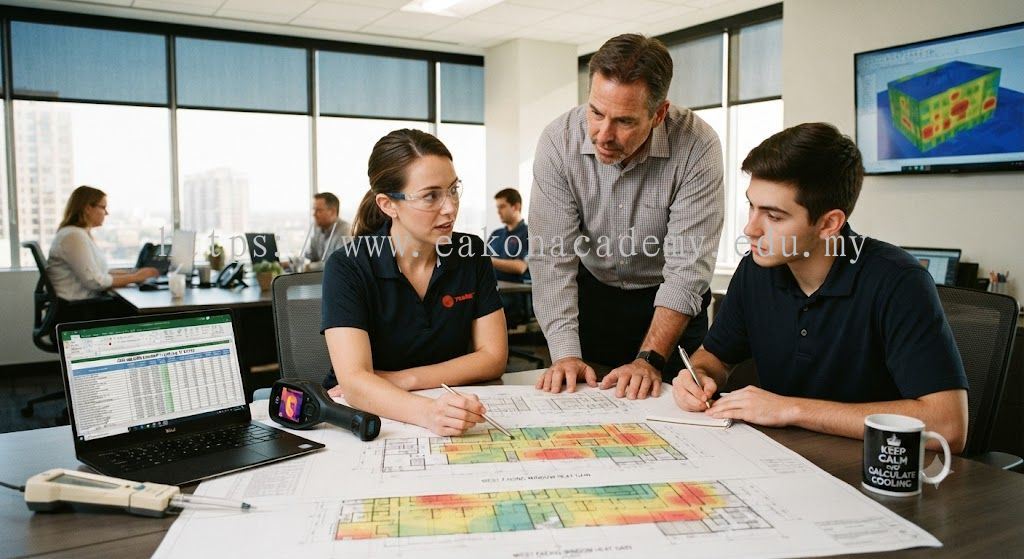
Commercial Air Conditioning Cooling Load Estimation: A Complete Guide to Accurate HVAC Design, Energy Efficiency, and System Performance
Commercial air conditioning cooling load estimation is one of the most important engineering processes in the HVAC (Heating, Ventilation, and Air Conditioning) industry. It is the foundation for designing efficient, reliable, and cost-effective cooling systems for commercial buildings such as offices, shopping malls, hotels, hospitals, educational institutions, restaurants, warehouses, factories, and mixed-use developments. Accurate cooling load estimation ensures that an air conditioning system is properly sized to maintain comfortable indoor temperatures, control humidity, optimize energy consumption, and deliver long-term operational performance. At Eakon Academy (eakonacadem.edu.my), HVAC technicians, engineers, consultants, contractors, and students receive professional training in commercial cooling load estimation using internationally recognized engineering methods, industry-standard software, and practical real-world applications.
Commercial air conditioning cooling load estimation is the process of calculating the total amount of heat that must be removed from a commercial building to maintain the desired indoor environmental conditions. Unlike residential buildings, commercial facilities often have more complex cooling requirements because of larger floor areas, higher occupancy levels, extended operating hours, sophisticated lighting systems, office equipment, manufacturing machinery, commercial kitchens, data centres, and ventilation systems. Every source of heat contributes to the overall cooling demand, making accurate calculations essential before selecting any HVAC equipment. Cooling load estimation includes both sensible heat, which increases air temperature, and latent heat, which increases moisture content in the indoor environment.
An accurate commercial cooling load estimation begins with a comprehensive assessment of the building. HVAC engineers evaluate room dimensions, ceiling heights, building orientation, wall construction, roof insulation, glazing performance, window size, shading devices, occupancy density, lighting power, electrical equipment, ventilation requirements, outdoor air infiltration, internal heat gains, and local climate conditions. These factors directly affect the building's cooling requirements and must be carefully analysed to produce reliable results. Commercial buildings frequently contain different zones with varying cooling demands, making zoning analysis another important component of professional cooling load estimation.
Proper commercial air conditioning cooling load estimation provides numerous advantages for both building owners and HVAC professionals. Correctly sized systems maintain stable indoor temperatures, improve occupant comfort, provide effective humidity control, reduce electricity consumption, minimize equipment wear, and lower long-term operating costs. Accurate cooling load calculations also improve airflow distribution, optimize chiller performance, reduce compressor cycling, and increase the service life of air handling units, fan coil units, cooling towers, pumps, and other HVAC components. Businesses benefit from lower utility expenses, improved employee productivity, and more reliable indoor environmental conditions throughout the year.
Incorrect cooling load estimation can lead to significant operational and financial problems. An undersized commercial air conditioning system may struggle to meet cooling demands during peak occupancy or high outdoor temperatures. Continuous operation increases electricity consumption, places excessive stress on compressors, and accelerates equipment failure. Conversely, an oversized system cycles on and off frequently, reducing energy efficiency, causing inadequate humidity removal, increasing maintenance costs, and shortening equipment lifespan. Professional cooling load estimation ensures that HVAC equipment is precisely matched to the building's actual thermal requirements, preventing costly installation mistakes and improving overall system performance.
Commercial HVAC engineers use several internationally accepted cooling load calculation methods when designing air conditioning systems. Common engineering methodologies include the Cooling Load Temperature Difference (CLTD) method, Cooling Load Factor (CLF), Radiant Time Series (RTS) method, Heat Balance (HB) method, and guidelines published by ASHRAE. These methods evaluate conductive heat transfer, solar heat gain, lighting loads, occupancy schedules, ventilation rates, equipment heat generation, infiltration, and weather conditions. By applying these proven engineering techniques, HVAC professionals can accurately estimate cooling loads and design high-performance commercial air conditioning systems that comply with international standards.
In tropical climates such as Malaysia, commercial air conditioning cooling load estimation becomes even more critical due to consistently high temperatures, elevated humidity, and strong solar radiation throughout the year. Commercial buildings often operate for long hours and experience continuous occupancy, increasing cooling demands significantly. HVAC engineers must carefully evaluate roof exposure, glazing systems, façade design, insulation materials, fresh air requirements, equipment density, and internal heat gains to ensure optimal system performance. Accurate cooling load estimation helps reduce electricity consumption while maintaining comfortable indoor conditions despite Malaysia's demanding environmental conditions.
Modern HVAC engineering increasingly relies on advanced cooling load simulation software to support commercial building design. Professional applications such as Carrier HAP, Trane TRACE 3D Plus, EnergyPlus, IES VE, and DesignBuilder enable engineers to analyse building performance, calculate hourly cooling loads, compare design alternatives, and optimize equipment selection. These software tools significantly improve calculation accuracy and project efficiency. However, engineering knowledge remains essential because software outputs are only as reliable as the building data entered into the model. HVAC professionals must understand thermodynamics, heat transfer, psychrometrics, ventilation, sensible heat, latent heat, and building envelope performance to validate software results and produce dependable engineering designs.
At Eakon Academy, students receive comprehensive hands-on training in commercial air conditioning cooling load estimation through engineering workshops, practical calculation exercises, HVAC design projects, and real commercial building case studies. Participants learn how to collect building data, calculate sensible and latent cooling loads, evaluate ventilation systems, interpret architectural and mechanical drawings, perform zoning analysis, and select appropriate commercial HVAC equipment. The academy combines engineering theory with practical field experience, preparing graduates to confidently design, install, commission, troubleshoot, and optimize commercial air conditioning systems according to international engineering standards.
As commercial buildings continue to prioritize energy efficiency, sustainability, smart building technologies, and environmentally responsible design, expertise in commercial air conditioning cooling load estimation has become one of the most valuable skills in the HVAC industry. Accurate cooling load calculations improve equipment performance, reduce operational costs, enhance indoor environmental quality, support green building certification programs, and extend HVAC system lifespan. By enrolling in professional HVAC training at Eakon Academy (eakonacadem.edu.my), technicians, engineers, consultants, contractors, and students can strengthen their technical expertise, master advanced cooling load estimation methods, and gain practical skills that are highly valued across the commercial HVAC sector. Whether working on office buildings, retail centres, hotels, hospitals, educational facilities, or industrial complexes, mastering commercial cooling load estimation provides the technical foundation for designing high-performance, energy-efficient air conditioning systems that meet the evolving demands of the modern built environment.
Lebih maklumat tentang EAKON ACADEMY SDN BHD Malaysia
