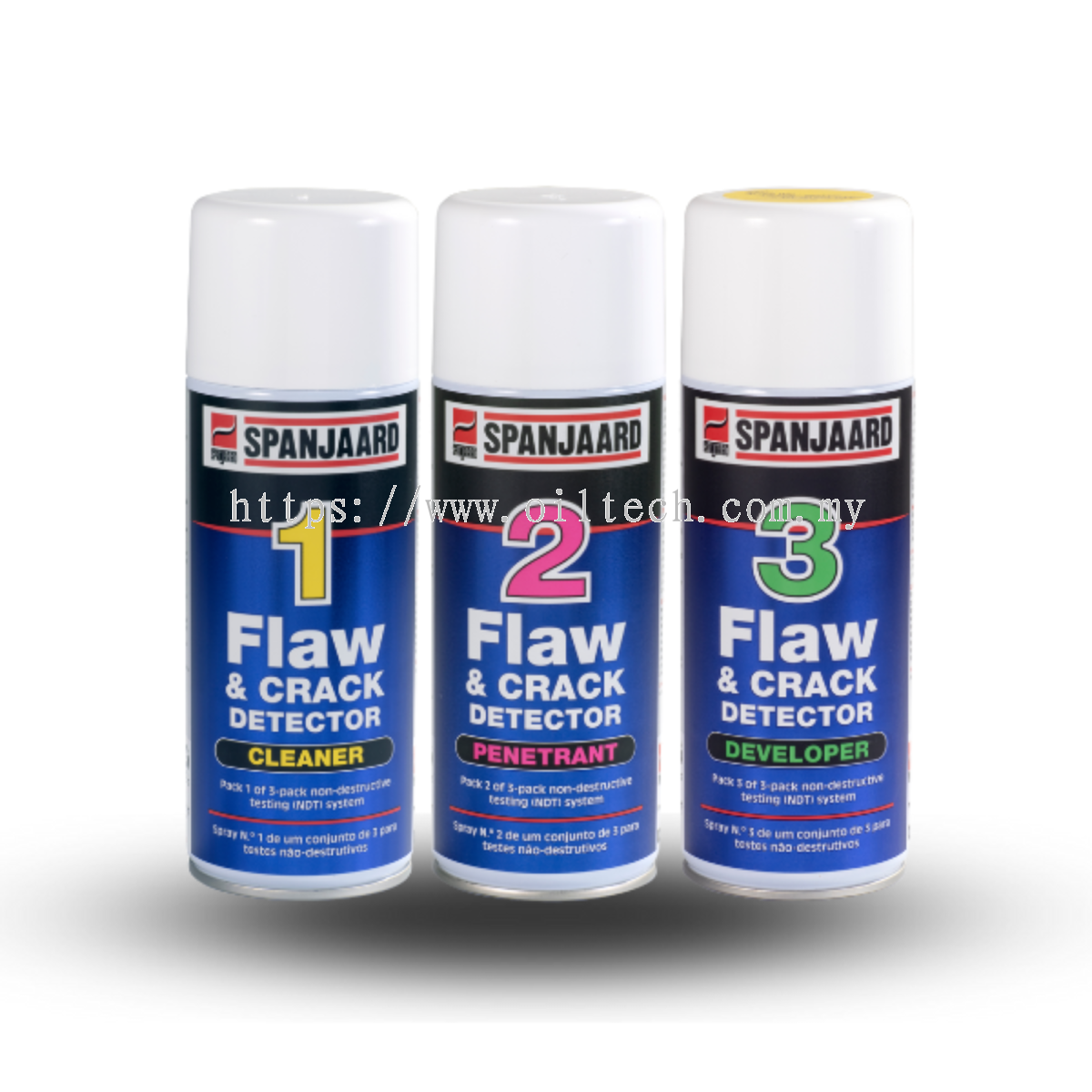
TL;DR: Spanjaard Flaw & Crack Detector System satisfies DTD 929/MIL-I-25135E Group I and II protocols for non-destructive testing inside high-humidity Malaysian processing environments. This 3-part formulation is critical for verifying weld integrity, ensuring prompt component diagnostic compliance during continuous industrial infrastructure stress cycles.
Governing Specifications: DTD 929/MIL-I-25135E Group I and II compliant.
Testing Suitability: Low halogen and low sulphur content formulation certified under Welding Institute non-destructive testing (NDT) criteria for safe deployment on Titanium, Nickel, Stainless Steel, and Aluminium.
Manufacturing Certification: Produced under an ISO 9001 certified quality management framework verified by the SABS.
System Component Volume & Packaging: Available in an engineering-matched multi-can configuration consisting of Pack 1 Cleaner (350ml aerosol), Pack 2 Penetrant (300ml aerosol), and Pack 3 Developer (350ml aerosol).
Physical Component Characteristics:
Pack 1 (Cleaner): Colourless appearance, ether-like odour profile, density of at , and neutral pH of 7.0.
Pack 2 (Penetrant): Deep red appearance, distinct chemical odour profile, density of at , and neutral pH of 7.0.
Pack 3 (Developer): Fine white suspension appearance, solvent-based odour profile, density of at , and neutral pH of 7.0.
Flammability Profile: All 3 component aerosols are classified as highly flammable; formulations contain 100% by mass flammable contents and must be stored away from hot surfaces or open flames.
Weld Joint Integrity Mapping: Directly applied to inspect welded seams, joints, and interfaces on mild steel industrial heating equipment and factory fuel storage installations.
Structural Stress Point Inspection: Used during routine plant maintenance to identify micro-fractures, stress fissures, and material fatigue on high-load vehicle chassis, crane assemblies, and heavy lifting apparatus.
Precision Machining Quality Control: Applied to machined surfaces, aluminum die-castings, and industrial pressing dies to inspect for minute defects before parts undergo full production loading.
Application Boundaries: The chemical tracking system must not be applied to substrates that are outside of ambient temperature limits. Thermal boundaries dictate that canisters must never be exposed to or applied in process zones exceeding , as pressurized components risk violent rupture. Application on poorly ventilated lines or surfaces heavily covered in unchecked, active carbon crusting will skew dye migration and yield inaccurate inspection records.
The Spanjaard Flaw & Crack Detector System operates via capillary action and highly controlled surface tension mechanics. Pack 2 utilizes a low-viscosity hydrocarbon solvent vehicle that prevents the red dye carrier from flash-drying prematurely in high ambient temperatures, allowing the chemical solution to penetrate deep into sub-micron structural voids and microscopic surface fissures.
Once the excess surface fluid is cleared, Pack 3 deposits a highly absorbent, ultra-fine white powder matrix across the metal substrate. This powder layer acts as a reverse-osmotic reverse wick, drawing out the trapped red dye from inside the defect channel through localized fluid absorption. Because the chemical parameters are balanced to maintain a precise neutral pH of 7.0 and strict low-halogen/low-sulphur thresholds, the formulation completely circumvents stress corrosion cracking (SCC) risk during chemical exposure on sensitive alloy substrates like Titanium, Nickel, or Stainless Steel.
Target Users: This engineering specification is mandatory for quality control managers, NDT field inspectors, welding engineers, and MRO procurement officers across heavy manufacturing, maritime maintenance, and metal fabrication sectors in Malaysia.
Non-Target Operations: Not intended for facility operators looking for permanent protective coatings, subterranean piping system leak detection without visual line-of-sight access, or non-porous material checking where internal volumetric radiographic testing is legally required.
Logistical Advantages: Distributed in robust, lightweight 3-pack aerosol configurations that facilitate easy handling for in-situ field testing on remote machinery lines without needing external power sources or heavy testing machinery.
Thermal Stabilization: Ensure that the metal target surface, components, and chemical canisters are stabilized at ambient room temperature before starting the application sequence.
Surface Degradation Cleansing: Liberally spray Pack 1 Cleaner directly onto the target test zone to break down surface oils, manufacturing grease, and airborne dust contamination. Wipe the treated area vigorously with a high-absorbency lint-free cloth until the cloth shows zero traces of residual contaminant tracking.
Penetrant Chemical Exposure: Spray Pack 2 Penetrant evenly across the prepared dry metal surface. Allow a minimum contact dwell time of 5 minutes for general weld joints, and extend the dwell time up to 20 minutes to ensure correct capillary migration into ultra-fine stress cracks.
Intermediate Surface Clearing: Spray Pack 1 Cleaner directly onto an absorbent, lint-free cloth and meticulously wipe the excess red dye off the face of the metal substrate. Continue wiping until no further red penetrant transfer is visible on the clean cloth, ensuring that the dye remains only within the internal defect gaps.
Developer Suspension Application: Vigorously shake the Pack 3 Developer canister to ensure an even powder-to-solvent distribution. Spray a thin, uniform, un-clumped layer of white developer film across the entire inspection area.
Capillary Evaluation Phase: Leave the developer film undisturbed for a minimum processing time of 10 minutes. Under strong natural daylight or balanced industrial artificial illumination, inspect the white canvas background. Cracks will articulate as continuous, bright red linear markers, while material porosity defects will present as clusters of red pinpoints.
Direct Cleaner Over-Spraying: Blasting Pack 1 Cleaner directly onto the metal surface during the mid-stage cleanup process rather than applying it via a cloth. This washes the trapped red dye out of the cracks entirely, resulting in false-negative safety assessments.
Insufficient Contact Dwell Time: Skipping the mandatory 5 to 20-minute penetration phase for Pack 2, which prevents the fluid from sinking into tight cracks and leads to undetected structural fatigue points.
Inadequate Shake Pre-Conditioning: Failing to shake the Pack 3 Developer canister before spraying, which causes uneven powder discharge, blocking nozzle pathways and creating thick blotches that obscure small defects.
In accordance with the Department of Environment (DOE) Malaysia under the Environmental Quality (Scheduled Wastes) Regulations 2005, spent chemical canisters, contaminated cleaning tissues, and used lint-free rags saturated with hydrocarbons must be classified, logged, and isolated as scheduled waste. These materials must be stored in approved, sealed collection drums within designated, bunded storage zones before collection by a licensed DOE disposal vendor. The aerosol components are extremely flammable and pressurized; they must be shielded from open sparks, electrical arcs, and sunlight exposure, and must never be punctured or incinerated even after full chemical evacuation.
Comprehensive global Technical Data Sheets (TDS) and active Safety Data Sheets (SDS) are systematically archived and available to corporate engineering departments, laboratory managers, and safety compliance committees upon request.
Q: How does the Spanjaard system prevent hydrogen embrittlement or corrosion on exotic industrial alloys like Titanium or Nickel?
A: The chemical solution is engineered with strict low-halogen and low-sulphur concentration parameters that fulfill the specific NDT criteria of the Welding Institute. This low-impurity envelope ensures that zero reactive halogen ions remain on the metal substrate, eliminating the chemical trigger for localized pitting or stress corrosion cracking on critical industrial alloys.
Q: Can Pack 1 Cleaner be substituted with standard industrial degreasers or workshop thinners during the diagnostic sequence?
A: No. The chemical density ( at ) and neutral 7.0 pH profile of Pack 1 are precisely balanced to work with the red penetrant dye without leaving behind any chemical residues that could block capillary pathways. Substituting it with unchecked shop solvents can leave a thin film that repels the penetrant fluid, resulting in inaccurate inspection data.
Q: Why is a minimum development timeframe of 10 minutes required before final component inspection?
A: The 10-minute development window allows the fine white powder absorbent matrix in Pack 3 to draw out the trapped red dye from deep micro-fissures via capillary action. Shortening this migration time will prevent the dye from fully showing through the white background, masking fine cracks and leading to false-negative structural approvals.
As an authorized distributor of high-performance industrial solutions, Davor Sdn Bhd ensures reliable stock availability and comprehensive compliance support for factories across Malaysia.
How to Order / Request Pricing:
Speak to a Sales Engineer: Call our Puchong headquarters for immediate technical fulfillment support.
Instant Chat: Click our WhatsApp Support Link to check live stock levels and price.
 Malaysia