
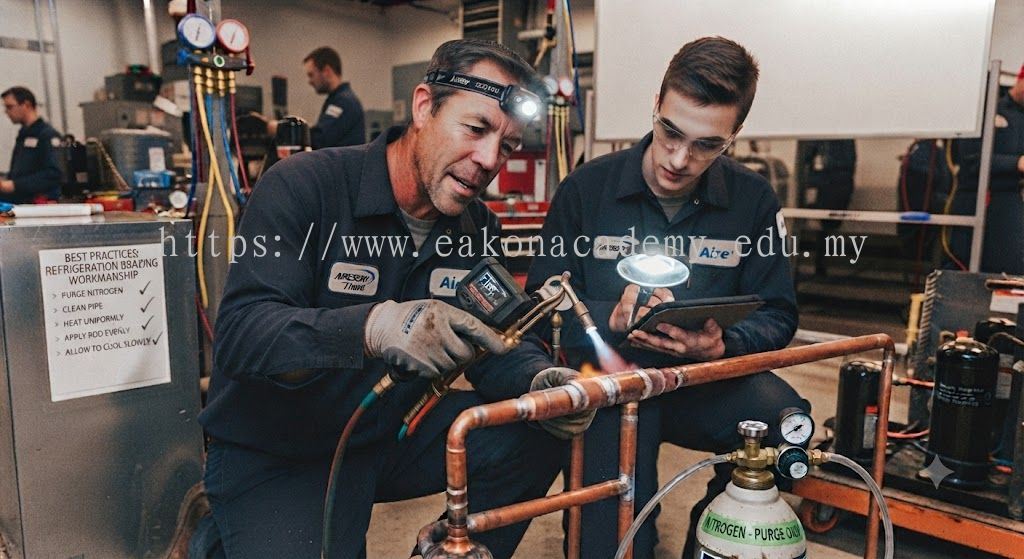
Refrigeration HVAC Brazing Workmanship Best Practices
Eakon Academy is a professional HVAC-R training institution dedicated to developing highly skilled technicians through structured, hands-on education in refrigeration and air conditioning systems. One of the most important technical and professional development areas in this field is refrigeration HVAC brazing workmanship best practices, which focuses on achieving high-quality, precise, and reliable copper pipe joints in refrigeration systems. Workmanship in brazing is not only about joining copper pipes but also about demonstrating accuracy, consistency, safety, and adherence to industry standards. Poor workmanship can lead to refrigerant leaks, reduced system efficiency, compressor damage, and costly maintenance issues, making proper training and disciplined execution essential for HVAC professionals.
Refrigeration HVAC brazing workmanship best practices begin with proper planning and preparation. Skilled technicians must carefully review system layouts, measure pipe lengths accurately, and ensure correct alignment before any brazing work begins. Copper pipes must be cut cleanly, deburred, and thoroughly cleaned to remove contaminants such as oil, dust, oxidation, and moisture. Clean surfaces are essential for achieving strong metallurgical bonding during the brazing process. Proper joint fit-up is also a key part of good workmanship, as correct clearance allows capillary action to evenly distribute the brazing filler metal throughout the joint, ensuring a strong and leak-free connection.
Attention to detail is a defining characteristic of refrigeration HVAC brazing workmanship best practices. Technicians must ensure that every joint is properly aligned and supported before heating begins. Poor alignment can introduce stress into the system, leading to premature joint failure or refrigerant leakage. Good workmanship requires patience, precision, and consistency at every stage of the brazing process, especially when working in confined or complex installation environments.
Heat control and torch handling are central to high-quality HVAC brazing workmanship. Technicians must apply heat evenly around the joint using a controlled flame technique to ensure uniform temperature distribution. Overheating can damage copper tubing, burn flux, and weaken joint integrity, while insufficient heating prevents proper filler metal flow. Skilled HVAC professionals are trained to maintain steady torch movement and observe copper color changes to determine the correct brazing temperature. This level of control ensures consistent, professional-grade results across all brazed joints.
Nitrogen purging is an essential component of refrigeration HVAC brazing workmanship best practices. By introducing a controlled flow of nitrogen during brazing, technicians prevent internal oxidation inside copper pipes. This ensures that the internal surfaces remain clean and free from scale formation, which could otherwise reduce system efficiency and cause long-term operational issues. Proper nitrogen use reflects a high level of workmanship and adherence to modern HVAC-R standards.
The selection and application of brazing filler metals also reflect workmanship quality. Silver-based alloys are commonly used due to their strength, flow characteristics, and compatibility with copper tubing. Skilled technicians must apply filler rods at the correct temperature to ensure complete penetration and uniform joint sealing. Proper flux usage, when required, further enhances bonding and ensures smooth, consistent results.
Post-brazing inspection and testing are critical elements of refrigeration HVAC brazing workmanship best practices. Technicians must visually inspect joints for uniform appearance, check for defects such as cracks or voids, and perform pressure or leak testing to verify system integrity. These steps ensure that all work meets HVAC-R industry standards and delivers long-term reliability.
At Eakon Academy, students are trained through hands-on HVAC-R programs that emphasize refrigeration HVAC brazing workmanship best practices in real-world applications. The training focuses on precision, discipline, and professional standards to prepare learners for successful careers in residential, commercial, and industrial HVAC systems.
In conclusion, mastering refrigeration HVAC brazing workmanship best practices is essential for producing high-quality, durable, and leak-free refrigeration systems. Proper training, attention to detail, and disciplined execution ensure long-term system performance and professional excellence in the HVAC-R industry.
更多 EAKON ACADEMY SDN BHD 相关资料 Malaysia
