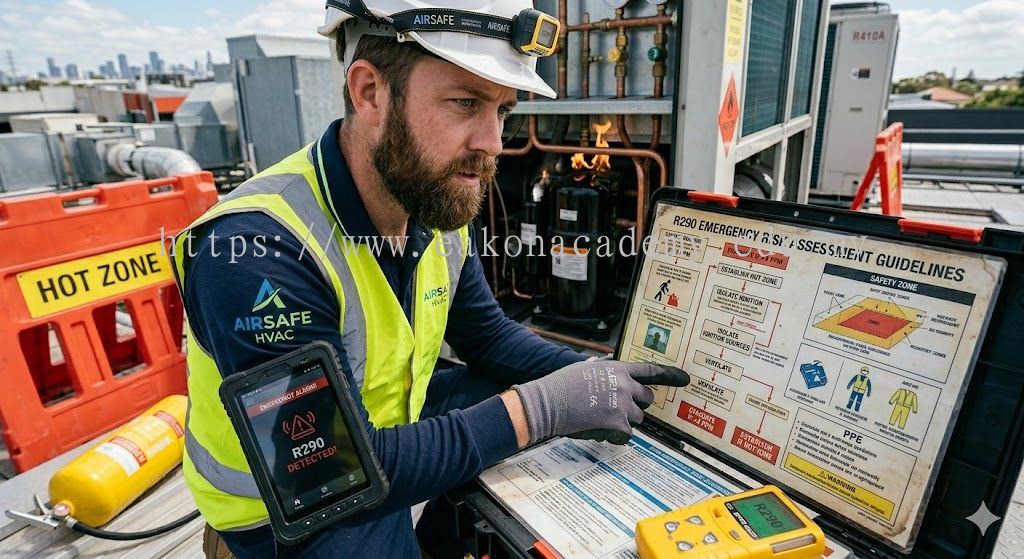
R290 Emergency Risk Assessment Guidelines – Professional Safety Procedures for Hydrocarbon Refrigerant Systems
R290 emergency risk assessment guidelines are an important part of safe hydrocarbon refrigerant management for modern HVAC and refrigeration professionals. With the increasing adoption of R290 propane refrigerant due to its low Global Warming Potential (GWP) and zero Ozone Depletion Potential (ODP), understanding emergency response procedures and risk control methods has become essential for technicians, contractors, facility managers, and refrigeration businesses. Eakon Academy provides professional technical education and competency development to support the HVAC industry in improving safety awareness, refrigerant handling skills, and compliance with recommended safety practices.
R290 refrigerant is classified as an A3 flammable refrigerant, meaning it has high flammability characteristics and requires careful management during installation, servicing, maintenance, recovery, and emergency situations. R290 emergency risk assessment guidelines help technicians identify possible hazards, evaluate potential consequences, and implement effective preventive measures before performing any work involving propane refrigerant systems. A proper emergency risk assessment includes identifying ignition sources, evaluating refrigerant leak possibilities, checking ventilation conditions, and preparing suitable emergency response actions to reduce workplace risks.
One of the key elements of R290 emergency risk assessment guidelines is understanding the correct response procedures during refrigerant leakage incidents. When an R290 leak occurs, technicians must be able to recognize potential dangers caused by the accumulation of flammable refrigerant vapour. Immediate actions may include stopping the refrigerant release when safe to do so, removing ignition sources, improving ventilation, and restricting access to the affected area. Proper emergency planning ensures that technicians can respond quickly and safely while minimizing risks to personnel, equipment, and surrounding environments.
Effective R290 emergency risk assessment also requires knowledge of fire prevention and control measures. Since propane refrigerant can ignite when mixed with air within its flammable concentration range, technicians must understand the importance of controlling sparks, electrical sources, open flames, and other potential ignition hazards. Emergency procedures should include the use of suitable safety equipment, correct handling techniques, and awareness of workplace conditions that may increase risk during refrigerant servicing activities.
Another important aspect of R290 emergency risk assessment guidelines is technician training and competency development. Working with flammable refrigerants requires specific knowledge of refrigerant properties, safe charging methods, leak detection techniques, cylinder handling procedures, and emergency response planning. Proper training allows HVAC professionals to make informed decisions when dealing with unexpected situations such as refrigerant leakage, equipment failure, accidental release, or system damage.
R290 safety risk assessment procedures also support businesses in improving workplace safety management and meeting industry expectations for environmentally responsible refrigeration practices. Companies that implement structured emergency response plans can reduce operational risks, protect workers, and improve confidence when handling modern low-GWP refrigerant technologies. As regulations and environmental requirements continue to encourage sustainable refrigerant solutions, knowledge of R290 emergency procedures is becoming an important skill for the next generation of HVAC professionals.
Eakon Academy focuses on providing relevant HVAC technical knowledge that supports industry development through professional training, safety awareness, and practical refrigerant management skills. Understanding R290 emergency risk assessment guidelines enables technicians to work more confidently with propane refrigerant systems while maintaining high standards of safety and environmental responsibility. By developing strong competency in R290 hazard identification, emergency response planning, and safe servicing practices, HVAC professionals can contribute to a safer and more sustainable refrigeration industry.
For technicians, contractors, and organizations looking to enhance their knowledge of hydrocarbon refrigerant safety, R290 emergency risk assessment guidelines represent a valuable foundation for improving workplace protection, reducing accident risks, and ensuring responsible refrigerant management practices. Through proper education and continuous skills development, the HVAC industry can achieve safer operations while supporting the global transition toward environmentally friendly refrigeration technologies.
Tingnan ang karagdagang mga detalye tungkol sa EAKON ACADEMY SDN BHD