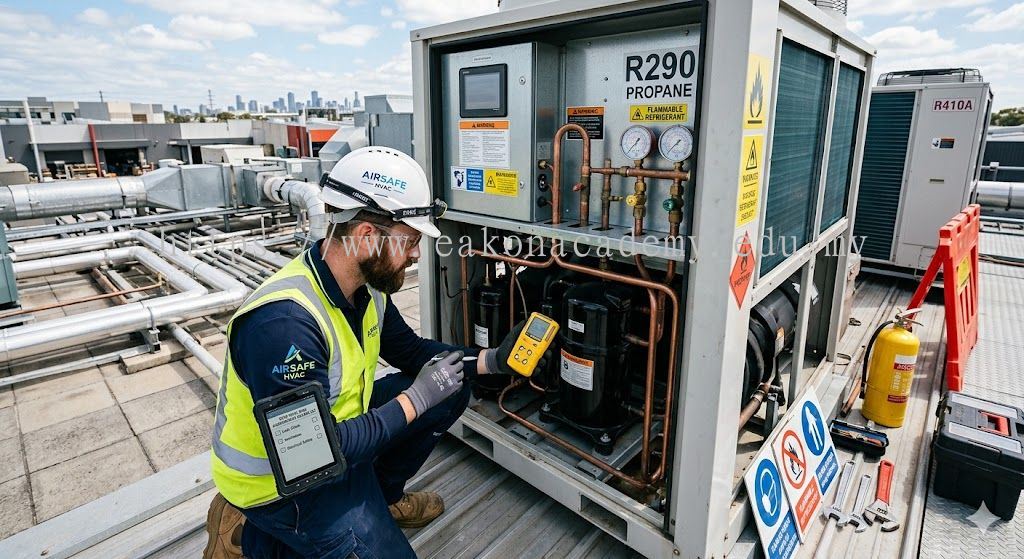
R290 Industrial HVAC Risk Assessment – Advanced Safety Evaluation for Large-Scale Hydrocarbon Refrigerant Applications
R290 industrial HVAC risk assessment is a crucial process for ensuring safe operation, installation, maintenance, and management of large-scale HVAC and refrigeration systems that utilise propane-based hydrocarbon refrigerants. As industries continue to adopt environmentally sustainable cooling technologies, R290 has become an attractive refrigerant option due to its excellent energy efficiency, low Global Warming Potential (GWP), and zero Ozone Depletion Potential (ODP). However, because R290 is classified as an A3 highly flammable refrigerant, industrial applications require comprehensive risk assessment procedures, safety planning, and professional competency to control potential hazards. Eakon Academy provides HVAC technical education and industry-focused training to enhance professional understanding of refrigerant safety, risk management, and sustainable cooling technologies.
A comprehensive R290 industrial HVAC risk assessment helps organisations identify, evaluate, and control potential hazards associated with the use of propane refrigerant in commercial and industrial environments. Unlike smaller residential applications, industrial HVAC systems often involve larger refrigerant quantities, complex piping networks, mechanical rooms, and continuous operation requirements. Therefore, proper risk assessment is essential to ensure that system design, installation practices, operating procedures, and maintenance activities meet high safety expectations.
One of the primary objectives of R290 industrial HVAC risk assessment is to identify possible refrigerant leakage risks. In industrial facilities, accidental refrigerant release may occur due to damaged components, improper connections, equipment failure, or incorrect maintenance procedures. Since R290 is flammable, leaked refrigerant can create hazardous conditions if it accumulates in enclosed areas and encounters an ignition source. A detailed assessment evaluates potential leakage locations, ventilation performance, refrigerant concentration risks, and appropriate mitigation strategies to maintain a safe working environment.
Another important element of industrial R290 risk assessment is evaluating ignition sources and controlling fire hazards. Industrial facilities may contain various electrical systems, machinery, heat sources, and operational equipment that could potentially become ignition points. Proper assessment procedures involve reviewing equipment location, electrical protection measures, ventilation requirements, and workplace conditions. Implementing effective control measures helps reduce the possibility of fire incidents and improves overall safety performance.
R290 industrial HVAC risk assessment also focuses on system design and engineering considerations. Large-scale propane refrigerant systems require careful planning regarding refrigerant charge limits, equipment selection, piping arrangement, safety devices, and installation locations. Engineers and HVAC professionals must consider factors such as room volume, airflow characteristics, equipment accessibility, and emergency shutdown procedures. A structured assessment ensures that industrial HVAC systems are designed with safety, reliability, and efficiency in mind.
Maintenance and servicing activities are also important areas covered in R290 industrial HVAC risk assessment. Technicians working on industrial refrigeration and air conditioning systems must follow appropriate procedures for refrigerant recovery, charging, leak testing, and component replacement. Using suitable tools, maintaining proper ventilation, and applying safe work practices are essential to minimise risks during servicing operations. Professional training enables technicians to handle hydrocarbon refrigerants with greater confidence and technical accuracy.
Emergency response planning is another key component of effective R290 industrial HVAC safety management. Industrial facilities should have clear procedures for handling refrigerant leaks, equipment failures, and unexpected safety incidents. Emergency plans should include methods for isolating affected areas, reducing ignition risks, improving ventilation, and protecting workers. Regular safety reviews and technician training help organisations maintain preparedness and improve workplace safety standards.
With increasing demand for energy-efficient and environmentally responsible HVAC solutions, R290 technology is expected to play an important role in the future of industrial cooling systems. However, successful implementation depends on effective risk assessment, proper safety management, and continuous professional development. Understanding R290 industrial HVAC risk assessment allows businesses to improve operational reliability while ensuring responsible refrigerant management.
Eakon Academy supports HVAC professionals, contractors, and organisations by providing technical knowledge related to refrigerant safety, industrial HVAC systems, and sustainable cooling technologies. By developing strong expertise in R290 industrial HVAC risk assessment, industry professionals can enhance their ability to identify hazards, implement safety controls, and maintain high standards of workplace protection. Proper risk assessment is a vital foundation for achieving safer, more efficient, and environmentally responsible industrial HVAC operations.
Tingnan ang karagdagang mga detalye tungkol sa EAKON ACADEMY SDN BHD