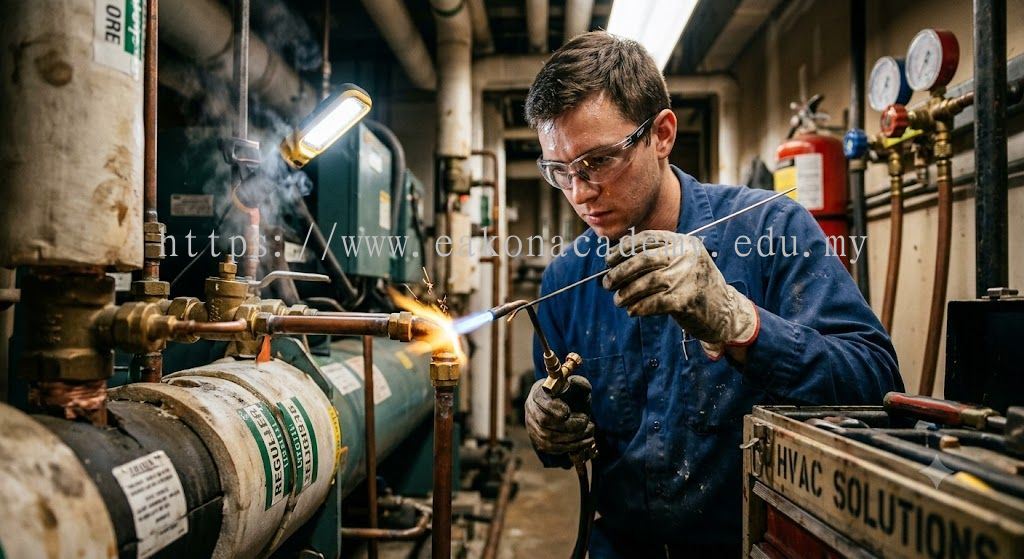
HVAC Refrigeration Brazing Procedure: Step-by-Step Professional Guide for Strong and Leak-Free Copper Pipe Systems
HVAC refrigeration brazing procedure is a fundamental process in air conditioning and refrigeration system installation that ensures strong, durable, and leak-free copper pipe connections. This procedure is essential because refrigeration systems operate under high pressure, temperature variations, and continuous working conditions. A properly executed brazing procedure guarantees efficient refrigerant flow, system reliability, and long-term performance. At Eakon Academy, HVAC training programs are designed to teach technicians the correct HVAC refrigeration brazing procedure through structured lessons, practical demonstrations, and real-world installation practice.
The HVAC refrigeration brazing procedure begins with proper safety preparation. Technicians must ensure that the working environment is clean, well-ventilated, and free from flammable materials before starting any brazing work. Personal protective equipment such as safety goggles, heat-resistant gloves, protective clothing, and safety shoes must be worn at all times. Gas cylinders, hoses, and brazing equipment must also be inspected for leaks or damage to ensure safe operation. Safety is the foundation of all professional HVAC brazing work.
The next step in the HVAC refrigeration brazing procedure is pipe preparation. Copper pipes must be accurately measured, cut, deburred, cleaned, and properly aligned before brazing begins. Any contamination such as oil, dust, moisture, or oxidation can weaken the brazed joint and lead to refrigerant leakage. Proper cleaning ensures that the brazing filler material flows smoothly through capillary action, creating a strong and uniform bond between copper surfaces. Correct alignment and fit-up are also essential for achieving high-quality brazed joints.
Heat control and torch setup are important steps in the HVAC refrigeration brazing procedure. Technicians must use a brazing torch with a properly adjusted flame to ensure even heat distribution around the joint. The copper tubing must be heated uniformly until it reaches the correct brazing temperature. Overheating can damage the pipe or cause oxidation, while insufficient heat may result in weak bonding. Skilled technicians learn to control flame intensity, torch movement, and heating patterns to achieve consistent brazing results.
Applying the brazing filler material is a key step in the HVAC refrigeration brazing procedure. Once the joint reaches the correct temperature, the filler rod is introduced, where it melts and flows into the joint through capillary action. This creates a strong metallurgical bond between copper components, ensuring a leak-free connection. Proper timing and technique are essential to ensure full penetration and strong joint formation.
Nitrogen purging is another critical part of the HVAC refrigeration brazing procedure. During brazing, high temperatures can cause internal oxidation inside copper pipes, leading to contamination that may circulate through the refrigeration system. This contamination can damage compressors, expansion valves, and filters. By introducing nitrogen flow during brazing, technicians can prevent oxidation and maintain clean internal pipe surfaces, improving system efficiency and reliability.
After brazing, cooling and inspection are essential steps in the HVAC refrigeration brazing procedure. The joint must be allowed to cool naturally to prevent thermal stress and cracking. Rapid cooling should be avoided as it may weaken the joint structure. Once cooled, technicians must perform visual inspection, pressure testing, and leak detection to ensure that all joints are properly sealed and safe for operation.
At Eakon Academy, HVAC training programs provide hands-on experience in the HVAC refrigeration brazing procedure. Trainees learn proper brazing techniques, nitrogen purging methods, safety procedures, and system testing skills. This practical training ensures that technicians are fully prepared for real-world HVAC installation and maintenance work.
Mastering the HVAC refrigeration brazing procedure is essential for technicians who want to succeed in the air conditioning and refrigeration industry. Proper brazing techniques improve system efficiency, reduce leakage risks, enhance safety, and extend equipment lifespan. With professional training and practical experience, HVAC technicians can deliver reliable, high-performance refrigeration systems that meet industry standards and customer expectations in residential, commercial, and industrial applications.
Tingnan ang karagdagang mga detalye tungkol sa EAKON ACADEMY SDN BHD