
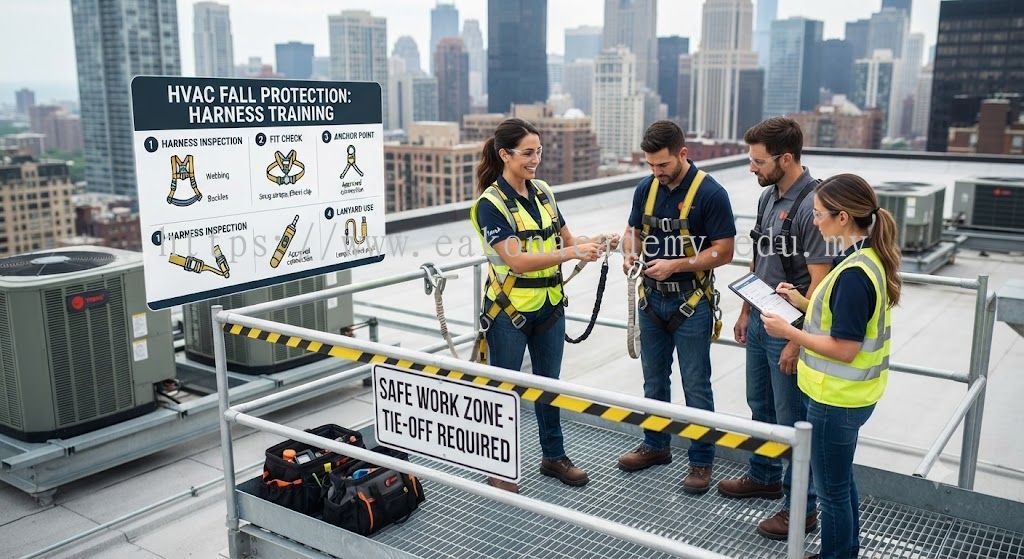
HVAC Safety Harness Training for Technicians: Essential Fall Protection Skills for Safe Working at Height
HVAC safety harness training for technicians is an important safety programme designed to provide air conditioning and refrigeration professionals with the knowledge and practical skills required to use fall protection equipment correctly when working at height. HVAC technicians often perform installation, maintenance, inspection, and repair activities in elevated areas such as rooftops, high-rise buildings, external walls, ceiling spaces, commercial facilities, industrial plants, and mechanical rooms. These working environments involve potential fall hazards that require proper safety planning, suitable protective equipment, and professional training. Understanding how to correctly select, inspect, wear, and maintain a safety harness helps technicians reduce workplace risks while improving confidence and productivity during elevated HVAC operations. At Eakon Academy (eakonacadem.edu.my), we integrate HVAC technical training with occupational safety education to prepare technicians with the skills required for safe and professional air conditioning work.
Working at height is a common requirement in modern HVAC projects, especially when installing outdoor condensing units, servicing rooftop air conditioning systems, maintaining VRF and VRV equipment, repairing commercial HVAC systems, and performing industrial refrigeration maintenance. During these activities, technicians may be exposed to fall risks caused by unstable surfaces, limited access areas, weather conditions, incorrect equipment usage, and unsafe work practices. HVAC safety harness training for technicians helps professionals understand the importance of fall protection systems and how safety harnesses contribute to preventing serious workplace injuries.
A major focus of HVAC safety harness training is understanding the different components of a complete fall protection system. Technicians learn about full-body harnesses, shock-absorbing lanyards, anchor points, lifelines, connectors, fall arrest devices, and positioning systems. Each component plays an important role in protecting workers when performing tasks at elevated locations. Proper training ensures technicians understand how these systems work together and how to select suitable equipment based on the specific HVAC work environment. Using the correct fall protection equipment is essential for maintaining safety during installation, servicing, and maintenance activities.
Proper inspection of safety harness equipment is another critical skill covered in professional training. Before every use, technicians should check harness straps, stitching, buckles, connectors, D-rings, lanyards, and attachment points for signs of damage, wear, corrosion, or defects. Even minor damage can affect the performance of fall protection equipment during an emergency situation. HVAC safety harness training for technicians teaches proper inspection procedures, storage methods, cleaning practices, and equipment replacement guidelines to ensure safety equipment remains reliable and effective.
Correct fitting and wearing techniques are essential when using safety harnesses. An improperly adjusted harness may not provide adequate protection during a fall event and can increase the risk of injury. Technicians are trained on how to correctly wear a full-body harness, adjust straps, position buckles, secure connections, and perform fit checks before starting work. Proper fitting ensures comfort, mobility, and maximum protection while allowing technicians to complete HVAC tasks efficiently.
Anchor point selection and attachment procedures are also important parts of HVAC safety harness training. Technicians must understand the importance of connecting harnesses only to suitable and approved anchor systems. Improper attachment methods can significantly reduce the effectiveness of fall protection equipment. Training helps technicians identify safe anchorage locations, understand connection limitations, and follow correct procedures when working on rooftops, elevated platforms, scaffolding, and other high-access areas.
In addition to harness usage, effective fall prevention requires proper workplace planning and hazard control. HVAC safety harness training teaches technicians how to conduct risk assessments, identify fall hazards, establish safe work zones, and implement preventive measures before starting work. Other important safety practices include maintaining stable footing, securing tools, controlling access areas, following safe ladder procedures, and communicating clearly with team members. A complete safety approach reduces accidents and supports professional HVAC operations.
Electrical safety is also connected with safety harness usage because HVAC technicians often perform electrical testing, wiring, troubleshooting, and commissioning while working at height. Training helps technicians understand how to combine fall protection procedures with electrical safety practices, including power isolation, safe tool usage, and hazard awareness. This integrated approach ensures technicians are protected from multiple workplace risks during complex HVAC projects.
At eakonacadem.edu.my, our professional HVAC training programmes focus on developing technicians with both technical expertise and strong workplace safety knowledge. Students receive hands-on training in air conditioning installation, maintenance, troubleshooting, refrigerant handling, electrical diagnostics, system commissioning, and HVAC servicing techniques. Safety training includes harness inspection, fall protection methods, working at height procedures, hazard identification, risk assessment, ladder safety, scaffold awareness, emergency response planning, and safe equipment handling. This practical training approach prepares technicians to perform HVAC work safely across residential, commercial, and industrial environments.
For HVAC contractors and employers, investing in HVAC safety harness training for technicians provides significant benefits. Properly trained technicians help reduce workplace accidents, improve compliance with safety requirements, increase productivity, minimise equipment damage, and strengthen customer confidence. Companies that demonstrate strong safety practices are more likely to build professional reputations and secure larger HVAC installation and maintenance projects. Safety-focused organisations also create better working environments that support long-term employee development.
As Malaysia’s HVAC industry continues to expand, technicians need more than technical installation skills; they require strong safety awareness and professional working practices. HVAC safety harness training for technicians ensures professionals are prepared to work safely at height while delivering reliable and high-quality HVAC services. Eakon Academy is committed to developing skilled HVAC technicians through industry-relevant training that combines hands-on technical education with comprehensive workplace safety practices. Visit eakonacadem.edu.my to explore our professional HVAC courses, air conditioning installation training, maintenance programmes, and safety-focused workshops designed to prepare technicians for successful careers in the heating, ventilation, air conditioning, and refrigeration industry.
Tingnan ang karagdagang mga detalye tungkol sa EAKON ACADEMY SDN BHD
