
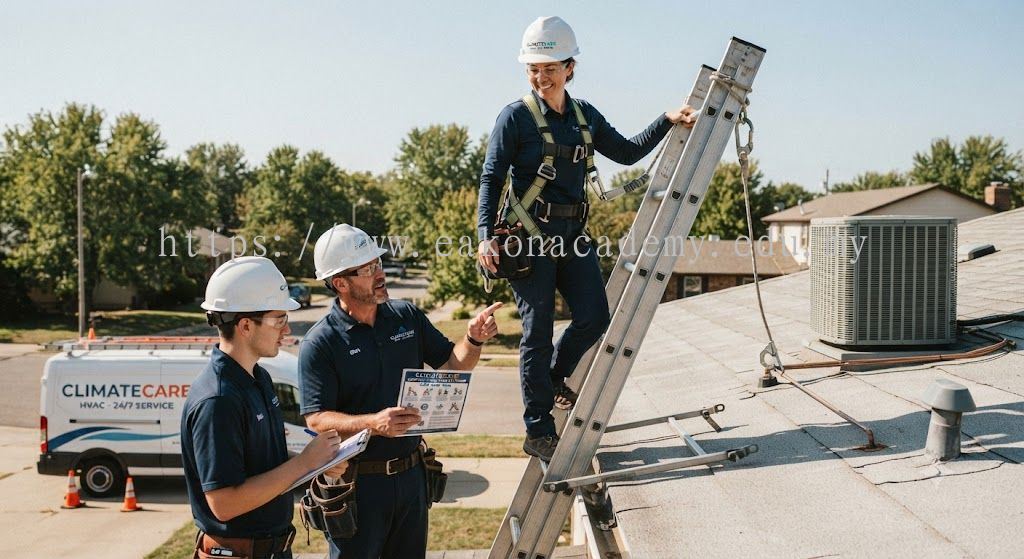
HVAC Occupational Safety Ladder Use Guide: Essential Best Practices for Safe HVAC Work at Height
Working at height is one of the most common tasks performed by HVAC technicians during the installation, servicing, maintenance, and repair of air conditioning and ventilation systems. Whether installing a split air conditioner, servicing rooftop package units, inspecting ductwork, or maintaining commercial HVAC equipment, technicians frequently rely on ladders to access elevated work areas. However, improper ladder selection, poor ladder setup, and inadequate safety practices can significantly increase the risk of falls, injuries, and property damage. This HVAC Occupational Safety Ladder Use Guide is designed to provide comprehensive information on safe ladder practices while strengthening workplace safety awareness among HVAC professionals. For individuals and companies looking to improve safety standards, Eakon Academy (eakonacadem.edu.my) offers professional HVAC safety training that emphasizes occupational safety, working at height procedures, and industry best practices in Malaysia.
Ladder safety begins with selecting the correct ladder for the specific HVAC task. Different projects require different ladder types, including step ladders, extension ladders, platform ladders, and fiberglass ladders for electrical safety. HVAC technicians should never use damaged, unstable, or undersized ladders that cannot safely support their weight, tools, and equipment. Before every use, ladders should be thoroughly inspected for cracked rails, bent steps, missing feet, loose hinges, damaged locking mechanisms, and other structural defects. Any damaged ladder should be removed from service immediately to prevent workplace accidents. Regular inspections are a critical component of every HVAC occupational safety program and demonstrate an employer's commitment to maintaining a safe work environment.
Correct ladder positioning is equally important. Extension ladders should be placed using the recommended 4-to-1 ratio, ensuring proper stability before climbing. The ladder should always rest on a firm, level surface and extend sufficiently above the landing point when accessing rooftops or elevated platforms. HVAC technicians should avoid placing ladders on slippery surfaces, uneven ground, loose gravel, or unstable objects such as boxes or pallets. Where necessary, ladder stabilizers, anti-slip feet, and securing straps should be used to enhance ladder stability and reduce movement during work activities. These preventive measures significantly reduce the likelihood of ladder-related incidents during HVAC installations and maintenance.
Maintaining proper climbing techniques is another essential aspect of ladder safety. Technicians should always maintain three points of contact by keeping either two hands and one foot or two feet and one hand on the ladder at all times. Carrying heavy equipment while climbing should be avoided whenever possible. Instead, tool belts, rope systems, or lifting devices should be used to transport equipment safely. Workers should never overreach beyond the ladder's side rails, as this can shift the center of gravity and increase the risk of falls. If additional reach is required, the ladder should be repositioned rather than stretching beyond a safe working position. Safe climbing habits contribute significantly to reducing workplace injuries and improving overall job efficiency.
Environmental awareness is another key factor in HVAC ladder safety. Weather conditions such as rain, strong winds, excessive heat, or poor lighting can increase the hazards associated with working at height. Outdoor HVAC installations often expose technicians to changing environmental conditions that require additional risk assessments before work begins. Technicians should also identify nearby electrical hazards, overhead power lines, moving machinery, and pedestrian traffic that could affect ladder stability or worker safety. Conducting a thorough site-specific risk assessment helps identify potential hazards and implement suitable control measures before work starts.
Employers have an important responsibility to ensure that all HVAC personnel receive adequate occupational safety training, ladder safety education, and working at height competency development. Comprehensive training programs should include ladder inspection procedures, hazard identification, fall prevention techniques, emergency response planning, personal protective equipment (PPE) usage, and compliance with Malaysian occupational safety regulations. Regular refresher courses help reinforce safe work behaviors while keeping technicians updated with the latest industry standards and safety practices. Investing in continuous safety training not only protects workers but also improves productivity, enhances company reputation, and reduces costly workplace incidents.
At Eakon Academy (eakonacadem.edu.my), HVAC professionals can access industry-focused training programs that combine practical hands-on learning with occupational safety principles tailored to real workplace environments. By promoting safe ladder use, effective risk management, and compliance with industry safety requirements, organizations can create safer workplaces while improving the competency and confidence of their HVAC workforce. Incorporating keywords such as HVAC occupational safety ladder use guide, HVAC ladder safety training, working at height for HVAC technicians, air conditioning ladder safety procedures, HVAC fall prevention, HVAC workplace safety, ladder inspection checklist, HVAC technician safety training Malaysia, working at height compliance, and occupational safety for air conditioning technicians also strengthens search engine optimization (SEO), helping eakonacadem.edu.my attract professionals, contractors, employers, and students seeking trusted HVAC safety training and occupational safety education in Malaysia.
Tingnan ang karagdagang mga detalye tungkol sa EAKON ACADEMY SDN BHD
