
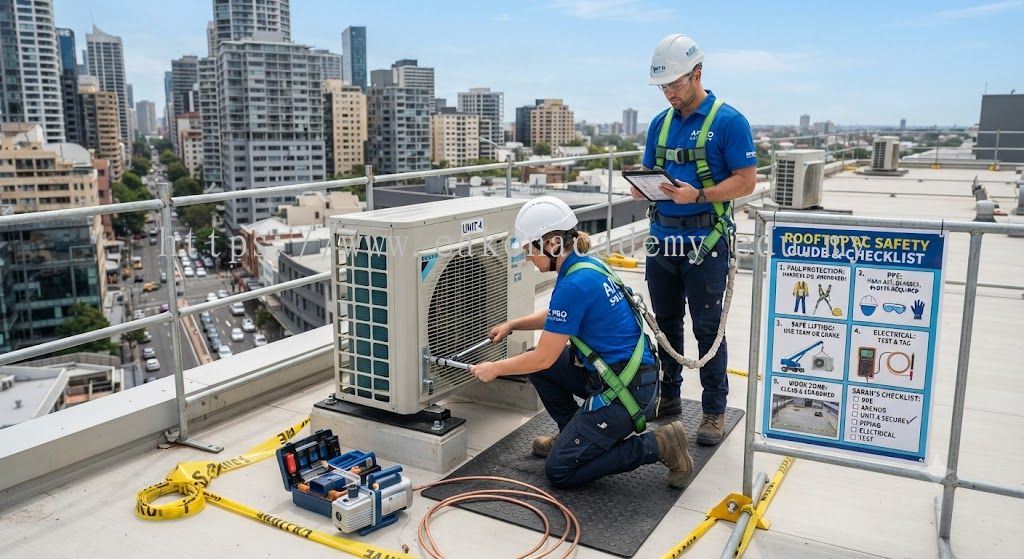
HVAC Rooftop Outdoor Unit Installation Safety Checklist: Essential Safety Practices for Professional HVAC Technicians
The installation of HVAC outdoor units on rooftops requires careful preparation, technical expertise, and strict safety procedures to ensure technicians can complete their work safely and efficiently. Rooftop HVAC installation is commonly performed for commercial buildings, industrial facilities, factories, offices, and high-rise properties where technicians must manage additional hazards compared to ground-level installation. These hazards may include working at height, roof edge risks, heavy equipment lifting, electrical exposure, weather conditions, and restricted access areas. A proper HVAC rooftop outdoor unit installation safety checklist helps technicians identify potential hazards, prepare suitable safety controls, and follow professional installation procedures to reduce workplace accidents. At Eakon Academy (eakonacadem.edu.my), we provide industry-focused HVAC safety training programmes designed to improve technician competency, strengthen workplace safety awareness, and support safer rooftop air conditioning installation practices throughout Malaysia.
Before starting any rooftop outdoor unit installation, HVAC technicians should conduct a detailed site inspection and safety assessment. The installation area must be evaluated to identify possible hazards such as unstable roof surfaces, slippery areas, weak structures, roof openings, limited access routes, and nearby electrical systems. A comprehensive safety checklist allows technicians to understand workplace conditions and prepare appropriate control measures before bringing equipment and tools onto the rooftop.
A key part of the HVAC rooftop outdoor unit installation safety checklist is working-at-height preparation. Rooftop installation often requires technicians to work near roof edges, elevated platforms, or external structures where fall hazards may exist. Technicians must ensure that suitable fall protection measures are available, including safety harnesses, lanyards, lifelines, guardrails, and approved anchorage points where required. Proper training in working-at-height procedures helps HVAC professionals understand how to prevent falls and maintain safe working positions during installation activities.
The inspection and preparation of access equipment should also be included in the safety checklist. Technicians may use ladders, scaffolding, Elevated Work Platforms (EWPs), scissor lifts, or boom lifts to access rooftop installation areas. Each type of equipment must be inspected before use to ensure it is safe and suitable for the task. Proper positioning, correct operation, and awareness of equipment limitations help reduce the risk of accidents during rooftop HVAC installation.
Equipment transportation and lifting procedures are another important section of the rooftop installation safety checklist. Outdoor condenser units can be heavy and difficult to move onto rooftops. Technicians must plan safe transportation routes, evaluate lifting requirements, and use suitable lifting equipment when necessary. For larger commercial HVAC systems, cranes, hoists, or mechanical lifting devices may be required. Proper communication between workers during lifting operations helps prevent dropped loads, equipment damage, and injuries.
Weather conditions must always be considered before and during rooftop HVAC installation work. Rain, strong winds, lightning, extreme heat, and poor visibility can increase safety risks for technicians working at height. A proper checklist should include weather evaluation procedures to determine whether installation activities can proceed safely. Responsible decision-making helps protect workers and prevents accidents caused by unsafe environmental conditions.
Electrical safety inspection is also an essential part of rooftop outdoor unit installation procedures. HVAC technicians must identify electrical hazards before connecting power supplies, control wiring, and testing equipment. Safe electrical practices, including proper isolation procedures and correct testing methods, help prevent electrical shocks, equipment failure, and workplace incidents.
Refrigerant handling safety should also be included in the installation checklist. Technicians must ensure that refrigerant piping connections, pressure testing, leak detection, and charging procedures are performed correctly. Proper refrigerant management improves system performance, reduces environmental impact, and creates safer working conditions for HVAC professionals.
Personal Protective Equipment (PPE) requirements are another important consideration for rooftop HVAC installation. Technicians should wear suitable PPE such as safety helmets, gloves, safety footwear, protective eyewear, and high-visibility clothing when required. Additional fall protection equipment may be necessary depending on the rooftop environment. Proper PPE selection and usage provide additional protection against common workplace hazards.
Tool and material organisation is also essential for rooftop installation safety. HVAC technicians use various tools, copper piping, electrical components, mounting materials, and refrigerant equipment during installation. A proper checklist should include procedures for securing tools and materials to prevent falling objects and maintain a clean working area. Good housekeeping improves safety and allows technicians to complete installation tasks more efficiently.
After installation is completed, technicians should perform a final inspection using a comprehensive safety checklist. The inspection should include checking outdoor unit stability, mounting support, vibration control, refrigerant connections, electrical wiring, drainage systems, and overall system operation. Proper inspection ensures that the HVAC system is installed safely and ready for reliable operation.
For HVAC companies, implementing a professional HVAC rooftop outdoor unit installation safety checklist provides many benefits, including reduced workplace accidents, improved technician performance, better compliance with safety requirements, and higher installation quality. A structured checklist ensures that every important safety factor is considered before, during, and after installation work.
At Eakon Academy (eakonacadem.edu.my), we are committed to developing competent HVAC professionals through comprehensive technical education and workplace safety training. Our HVAC rooftop outdoor unit installation safety checklist training provides essential knowledge and practical skills in rooftop safety assessment, hazard identification, working-at-height protection, lifting procedures, electrical safety, refrigerant handling, PPE requirements, and professional HVAC installation practices. Through industry-focused training and hands-on learning, HVAC technicians can strengthen their technical competency, improve workplace safety awareness, and confidently perform rooftop outdoor unit installation projects. By investing in professional HVAC safety training, technicians and companies can reduce workplace risks, improve operational efficiency, and contribute to a safer and more reliable HVAC industry throughout Malaysia.
Tingnan ang karagdagang mga detalye tungkol sa EAKON ACADEMY SDN BHD
