
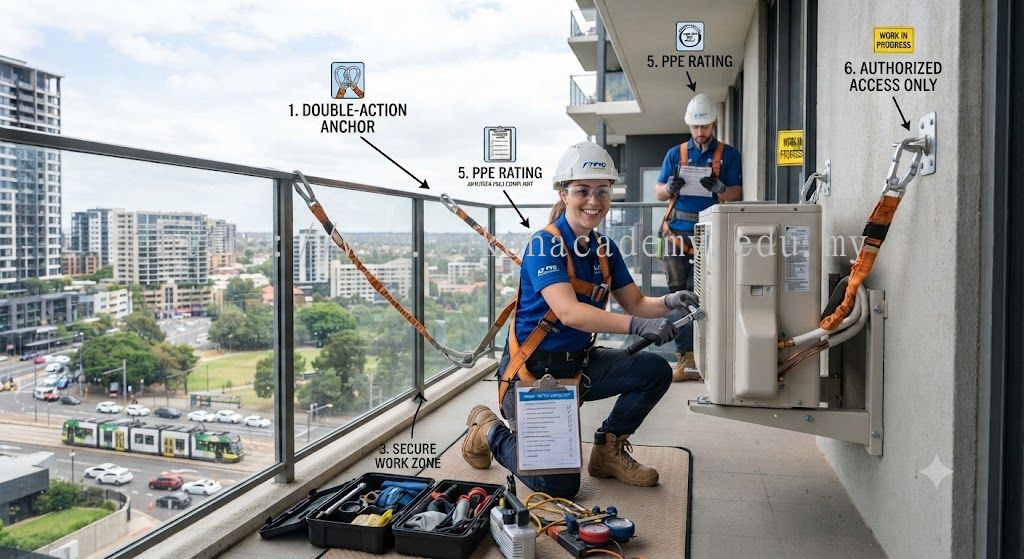
HVAC Technician Outdoor Unit Height Safety Guide: Professional Working at Height Practices for Air Conditioning Installation
The installation and maintenance of HVAC outdoor units often require technicians to perform tasks at elevated locations such as rooftops, external walls, balconies, commercial buildings, and industrial facilities. Working at height presents additional safety challenges that require proper knowledge, preparation, and professional training. HVAC technicians must understand how to identify potential hazards, use suitable safety equipment, and follow correct installation procedures to reduce workplace risks. The HVAC technician outdoor unit height safety guide provides essential information to help air conditioning professionals perform outdoor unit installation safely while maintaining high standards of workplace safety and technical performance. At Eakon Academy (eakonacadem.edu.my), we provide industry-focused HVAC safety training programmes designed to enhance technician competency, improve working-at-height awareness, and support safer air conditioning installation practices throughout Malaysia.
Outdoor unit installation involves various technical activities, including equipment lifting, mounting bracket installation, refrigerant piping connection, electrical wiring, testing, and commissioning. When these activities are performed at elevated locations, technicians must manage risks related to falls, unstable working areas, heavy equipment movement, electrical hazards, and changing weather conditions. A professional height safety approach ensures that HVAC technicians can complete installation work efficiently while protecting themselves, their colleagues, and the surrounding environment.
One of the most important elements of outdoor unit height safety is conducting a proper risk assessment before starting work. HVAC technicians must inspect the installation location and identify potential hazards such as roof edges, uneven surfaces, limited access areas, weak structures, slippery conditions, overhead obstacles, and nearby electrical systems. A detailed risk assessment helps technicians select appropriate control measures and prepare the correct tools and safety equipment before beginning installation activities.
Working-at-height protection is a critical requirement for HVAC technicians installing outdoor units. Many condenser units are positioned in locations where technicians may be exposed to fall risks. Proper safety procedures include using suitable Personal Protective Equipment (PPE) such as safety helmets, safety footwear, gloves, eye protection, and high-visibility clothing. Depending on the work environment, technicians may also require full-body safety harnesses, lanyards, lifelines, and approved anchorage systems. Proper training ensures that technicians understand how to inspect, wear, and use fall protection equipment correctly.
Safe access equipment selection is another important part of HVAC outdoor unit height safety. Technicians may use ladders, scaffolding, Elevated Work Platforms (EWPs), scissor lifts, or boom lifts to reach elevated installation areas. Each type of access equipment requires proper inspection and safe operating procedures. Understanding equipment limitations and selecting the correct access method helps reduce accidents and improves technician productivity during outdoor unit installation.
Equipment lifting and handling procedures must also be carefully planned when installing outdoor units at height. Condenser units can be heavy and difficult to position, especially on rooftops or upper-level locations. Improper lifting methods may result in injuries, equipment damage, or falling objects. HVAC technicians must understand safe lifting techniques, load assessment, communication procedures, and the correct use of lifting tools or mechanical equipment when required.
Weather conditions are another important factor in outdoor unit height safety. Rain, strong winds, lightning, extreme heat, and poor visibility can increase the possibility of slips, falls, and unsafe equipment movement. Technicians should evaluate environmental conditions before starting work and stop activities when conditions become unsafe. Proper judgment and safety awareness are essential skills for professional HVAC technicians.
Electrical safety must also be considered during outdoor unit installation at height. HVAC technicians often work with electrical power supplies, control wiring, isolators, and testing equipment while positioned above ground level. Safe electrical practices, including proper isolation procedures and correct testing methods, help prevent electric shock and equipment-related accidents.
Refrigerant handling procedures are also part of safe outdoor unit installation. Technicians must follow correct methods for connecting refrigerant piping, performing pressure testing, checking for leaks, and commissioning the system. Proper refrigerant practices ensure system efficiency while reducing safety and environmental risks.
Tool and material management plays an important role in preventing rooftop and elevated work accidents. HVAC technicians use many tools, copper pipes, electrical components, and installation materials that must be properly secured. Loose tools or materials can become falling object hazards and create risks for workers below. Good housekeeping practices improve safety and support more efficient installation work.
Communication and teamwork are essential during elevated HVAC installation projects. Technicians often work together with assistants, supervisors, electricians, contractors, and building personnel. Clear communication helps coordinate lifting activities, equipment positioning, installation procedures, and emergency responses. A strong safety culture ensures that all workers understand their responsibilities and follow established safety practices.
After completing the outdoor unit installation, technicians should conduct a final inspection to confirm that the equipment is securely mounted and operating correctly. Inspection should include checking mounting stability, refrigerant connections, electrical wiring, drainage systems, vibration control, and overall system performance. Proper inspection ensures long-term HVAC reliability and customer satisfaction.
For HVAC companies, implementing proper HVAC technician outdoor unit height safety guide procedures provides many advantages, including reduced workplace accidents, improved technician confidence, better safety compliance, and higher installation quality. Properly trained technicians are better prepared to handle challenging elevated HVAC projects while maintaining professional safety standards.
At Eakon Academy (eakonacadem.edu.my), we are committed to developing skilled HVAC professionals through practical and industry-focused training. Our HVAC technician outdoor unit height safety guide training provides essential knowledge and hands-on skills in hazard identification, risk assessment, fall protection, access equipment safety, lifting procedures, PPE requirements, and professional HVAC installation practices. Through comprehensive HVAC safety education, technicians can strengthen their technical competency, improve workplace safety performance, and confidently perform outdoor unit installation work at height. By investing in professional HVAC training, technicians and companies can reduce workplace risks, improve operational efficiency, and contribute to a safer and more reliable HVAC industry throughout Malaysia.
Tingnan ang karagdagang mga detalye tungkol sa EAKON ACADEMY SDN BHD
