
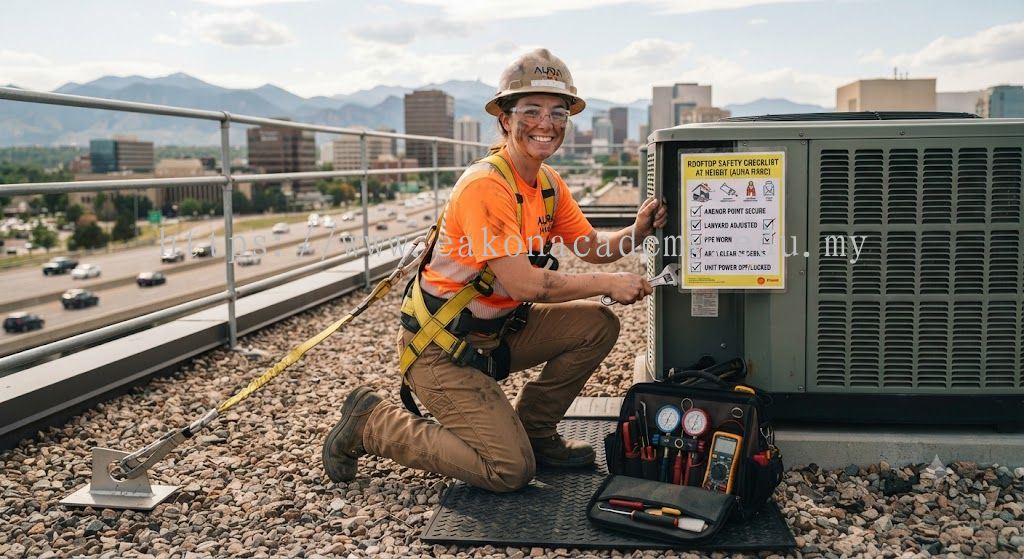
Air Conditioning Contractor Safety Checklist at Height: Complete Guide for Safe HVAC Work at Elevated Locations
Air conditioning contractor safety checklist at height is an essential resource for ensuring every HVAC installation, servicing, maintenance, inspection, and repair task performed above ground level is completed safely, efficiently, and in compliance with workplace safety regulations. Air conditioning contractors regularly work on rooftops, balconies, elevated platforms, ladders, scaffolding, ceiling spaces, and exterior building structures where fall hazards are present. Without a structured safety checklist, important safety procedures may be overlooked, increasing the likelihood of workplace accidents, equipment damage, project delays, and regulatory non-compliance. A comprehensive work-at-height safety checklist helps contractors systematically identify hazards, verify equipment readiness, confirm worker competency, and ensure all preventive measures are in place before work begins. At Eakon Academy (eakonacadem.edu.my), we provide practical HVAC safety training that teaches technicians, supervisors, and contractors how to apply effective safety checklists, conduct workplace risk assessments, and follow industry best practices to create safer working environments across residential, commercial, and industrial HVAC projects.
A well-designed air conditioning contractor safety checklist begins with thorough pre-work planning. Before technicians arrive at the worksite, supervisors should review the scope of work, identify potential hazards, evaluate weather conditions, and confirm that all required permits and approvals have been obtained. The checklist should include a detailed work-at-height risk assessment covering roof edges, fragile roofing materials, unstable surfaces, electrical hazards, confined spaces, overhead obstructions, falling object risks, and restricted access points. Planning should also ensure that emergency contact information, rescue procedures, communication devices, and first aid equipment are readily available. Taking time to complete these preliminary checks helps eliminate avoidable hazards while improving overall project coordination and safety performance.
The inspection of access equipment is another critical element within an effective height safety checklist. Air conditioning contractors frequently use extension ladders, step ladders, scaffolding, mobile elevated work platforms (MEWPs), boom lifts, scissor lifts, roof access systems, and temporary working platforms to reach HVAC equipment. Before use, each item should be carefully inspected for structural damage, loose components, corrosion, excessive wear, or missing safety features. Ladders should be positioned on stable surfaces, secured at the correct angle, and extend sufficiently above landing points to provide safe access. Scaffolding and elevated work platforms should only be assembled and operated by competent personnel following manufacturer recommendations and applicable safety regulations. Verifying access equipment before every task significantly reduces fall risks and enhances worker confidence during elevated HVAC operations.
Personal protective equipment (PPE) inspection is one of the most important sections of an air conditioning contractor safety checklist at height. Every technician should wear appropriate PPE, including a certified full-body safety harness, energy-absorbing lanyard, approved anchorage system, safety helmet with chin strap, slip-resistant safety boots, protective gloves, eye protection, and high-visibility clothing where required. The checklist should confirm that all PPE has been inspected before use, fits correctly, remains free from damage, and complies with relevant safety standards. Workers should also verify the compatibility of harnesses, connectors, anchor points, and fall arrest systems while ensuring adequate fall clearance is available. Regular PPE inspections and proper equipment maintenance help ensure reliable protection throughout every HVAC installation or maintenance project.
Tool and equipment safety should also be included within every work-at-height checklist. Air conditioning contractors rely on drills, grinders, vacuum pumps, refrigerant recovery machines, manifold gauges, pressure testing equipment, brazing torches, electrical testing instruments, and various hand tools. Each tool should be inspected for defects, electrical damage, loose parts, or operational issues before being used. Portable electrical equipment should be tested and properly grounded where necessary, while extension cords should be positioned to prevent tripping hazards. Tools used at height should be secured with lanyards whenever possible to prevent falling objects that could injure workers below or damage valuable equipment. Maintaining organized work areas further minimizes slip, trip, and fall hazards while improving operational efficiency.
The safety checklist should also verify that safe work procedures are fully understood by all personnel before work begins. Supervisors should conduct toolbox talks or pre-job safety briefings to discuss identified hazards, assigned responsibilities, emergency procedures, communication methods, and weather-related considerations. Workers should confirm their understanding of fall protection requirements, ladder safety rules, manual handling techniques, electrical isolation procedures, refrigerant handling practices, and emergency rescue protocols. Open communication encourages hazard reporting and promotes a proactive safety culture where every team member actively contributes to accident prevention.
Weather monitoring is another important item on any air conditioning contractor safety checklist at height. Rooftop HVAC work should never proceed during severe weather conditions such as heavy rain, lightning, strong winds, or extreme heat that may compromise worker safety. Wet roofing surfaces significantly increase slip hazards, while high winds can destabilize ladders, scaffolding, and elevated work platforms. Supervisors should continuously monitor changing weather conditions throughout the workday and implement stop-work procedures whenever environmental risks become unacceptable. Proper weather planning helps reduce unnecessary exposure to hazardous conditions while protecting both workers and equipment.
Emergency preparedness should always be verified before elevated work commences. The checklist should confirm that an emergency rescue plan is in place, rescue equipment is readily accessible, communication devices are functioning correctly, and workers know how to respond to falls, medical emergencies, or equipment failures. Rescue planning is particularly important when using fall arrest systems, as suspended workers require prompt rescue to reduce the risk of suspension trauma. Regular emergency drills improve response capability and ensure that rescue procedures can be implemented efficiently during real emergencies.
At Eakon Academy (eakonacadem.edu.my), we are committed to helping HVAC professionals achieve excellence in workplace safety through comprehensive training programs covering work-at-height safety, risk assessment, fall prevention, PPE inspection, emergency response, and safety management. Our industry-focused courses provide practical, hands-on learning that enables air conditioning contractors to confidently implement effective safety checklists while complying with occupational safety regulations and industry best practices. By consistently following an air conditioning contractor safety checklist at height, businesses can reduce workplace accidents, improve operational efficiency, protect valuable employees, enhance customer confidence, strengthen regulatory compliance, and build a reputation for delivering safe, reliable, and professional HVAC services. A structured safety checklist is not merely a compliance document—it is an essential tool that supports long-term business success, continuous improvement, and a strong culture of safety throughout the air conditioning and refrigeration industry.
Tingnan ang karagdagang mga detalye tungkol sa EAKON ACADEMY SDN BHD
