
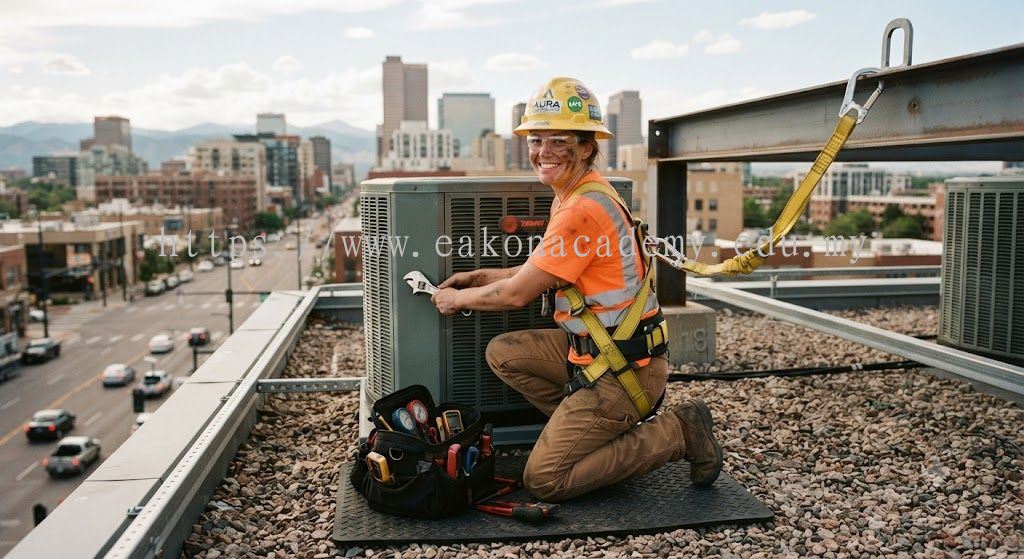
Air Conditioning Installation Contractor Height Safety Rules: Essential Guidelines for Safe HVAC Installation at Elevated Locations
Air conditioning installation contractor height safety rules are fundamental for ensuring the safety of HVAC professionals performing installation work at elevated locations such as rooftops, balconies, external building walls, scaffolding, elevated platforms, ceiling spaces, and multi-storey buildings. Air conditioning installation often requires technicians to work in environments where fall hazards are present, making strict adherence to height safety rules essential for preventing workplace injuries, protecting valuable equipment, and maintaining compliance with occupational safety regulations. Following comprehensive work-at-height procedures not only safeguards technicians but also improves installation quality, enhances productivity, and strengthens customer confidence. At Eakon Academy (eakonacadem.edu.my), we provide professional HVAC safety training that equips installation contractors with the practical skills, technical knowledge, and safety awareness required to carry out air conditioning installations safely while meeting industry standards and regulatory requirements. Through a combination of hands-on learning and real-world safety practices, our training programs help contractors build safer workplaces and deliver high-quality HVAC services across residential, commercial, and industrial sectors.
Every successful air conditioning installation project should begin with a comprehensive risk assessment before any work at height is performed. Contractors must identify potential hazards including roof edges, unstable working surfaces, fragile roofing materials, electrical hazards, overhead obstructions, poor weather conditions, falling objects, and limited emergency access routes. The findings of the risk assessment should be documented and incorporated into a Safe Work Method Statement (SWMS) or equivalent workplace safety procedure. Careful planning enables contractors to determine the safest installation methods, identify appropriate fall protection systems, allocate competent personnel, and establish emergency rescue procedures before work begins. A proactive approach to hazard identification significantly reduces workplace risks while ensuring every team member understands their responsibilities throughout the installation process.
One of the most important height safety rules for air conditioning installation contractors is using the correct access equipment. Depending on the work location and project requirements, technicians may require extension ladders, step ladders, scaffolding, mobile elevated work platforms (MEWPs), boom lifts, scissor lifts, or permanent roof access systems. Access equipment should always be selected according to the task, inspected before use, and maintained in accordance with manufacturer recommendations. Ladders should only be used for short-duration work and positioned on firm, level surfaces while maintaining the correct climbing angle. Workers should always maintain three points of contact when climbing and avoid carrying heavy equipment during ascent or descent. For larger or more complex installations, elevated work platforms or scaffolding provide safer and more stable working conditions while improving overall efficiency.
Fall prevention remains the highest priority whenever air conditioning installation work is carried out at height. Contractors should implement engineering controls such as guardrails, roof edge protection, warning lines, and designated walkways whenever practical. Where fall hazards cannot be eliminated, technicians should wear certified personal fall protection equipment including full-body safety harnesses, shock-absorbing lanyards, self-retracting lifelines, and approved anchorage systems. Every component of the fall protection system should be inspected before use to ensure it remains in good condition and complies with applicable safety standards. Workers should also receive competency-based training covering proper harness fitting, anchor point selection, fall clearance calculations, equipment limitations, and emergency rescue procedures. Correct use of fall protection equipment significantly reduces the severity of injuries should a fall occur.
Safe material handling is another essential height safety rule during air conditioning installation projects. Outdoor condensing units, indoor fan coil units, copper piping, refrigerant cylinders, compressors, ducting materials, insulation, and installation tools can be heavy and awkward to transport. Contractors should avoid manually carrying heavy equipment while climbing ladders or accessing rooftops. Mechanical lifting devices such as cranes, hoists, lifting straps, pulley systems, or material elevators should be used whenever possible to reduce physical strain and improve worker stability. Proper lifting techniques, good communication between team members, and careful route planning help prevent musculoskeletal injuries while minimizing the risk of dropped equipment and workplace accidents.
Weather conditions play a major role in determining whether installation work can be safely performed at height. Air conditioning installation contractors should continuously monitor weather forecasts before and throughout the workday. Heavy rain, strong winds, lightning, excessive heat, and poor visibility increase the likelihood of slips, trips, falls, heat stress, and equipment instability. Rooftop surfaces become particularly hazardous when wet, while strong winds may affect ladders, scaffolding, elevated work platforms, and suspended loads. Supervisors should establish clear stop-work procedures whenever environmental conditions present unacceptable risks and resume work only after conditions have improved and hazards have been reassessed.
Personal protective equipment (PPE) forms another critical element of height safety rules. Air conditioning installation contractors should wear safety helmets with chin straps, certified full-body harnesses, slip-resistant safety footwear, cut-resistant gloves, eye protection, hearing protection where necessary, and high-visibility clothing appropriate to the worksite. Respiratory protection may also be required when working in dusty ceiling spaces or handling insulation materials and refrigerants. PPE should be inspected before every use, maintained correctly, and replaced whenever damaged or no longer compliant with safety standards. While PPE provides essential protection, it should always be used together with effective engineering controls, administrative procedures, and safe work practices.
Electrical safety must also be integrated into every air conditioning installation project. Before connecting or installing HVAC equipment, contractors should isolate electrical power sources using lockout and tagout procedures where applicable. Electrical circuits should be tested to confirm they are de-energized before work begins. Insulated tools should be used when working near energized components, and all wiring should comply with applicable electrical standards and manufacturer specifications. Proper grounding, circuit protection, cable management, and equipment testing reduce the risk of electric shock, equipment damage, and fire hazards while ensuring long-term system reliability.
Emergency preparedness is another essential component of air conditioning installation contractor height safety rules. Every project should include a documented emergency rescue plan covering falls, medical emergencies, electrical incidents, refrigerant leaks, severe weather, and fire evacuation procedures. Rescue equipment should be readily accessible, communication systems should remain operational, and all workers should understand their responsibilities during emergency situations. Regular rescue drills and toolbox meetings reinforce safety awareness while ensuring workers can respond quickly and effectively should an incident occur.
At Eakon Academy (eakonacadem.edu.my), we are committed to developing highly competent HVAC professionals through practical, industry-focused training programs that combine technical excellence with workplace safety. Our courses cover work-at-height safety, fall prevention, PPE inspection, electrical safety, rooftop access, ladder safety, risk assessment, emergency response, and regulatory compliance to prepare contractors for real-world installation challenges. By consistently following air conditioning installation contractor height safety rules, HVAC companies can reduce workplace accidents, improve installation quality, strengthen legal compliance, enhance employee wellbeing, and build lasting customer trust. Prioritizing height safety not only protects lives but also supports sustainable business growth, operational excellence, and a strong reputation within the competitive air conditioning and refrigeration industry.
Tingnan ang karagdagang mga detalye tungkol sa EAKON ACADEMY SDN BHD
