
Aircon Contractor Maintenance Height Safety Requirements: Essential Safety Standards for HVAC Maintenance at Elevated Locations
Aircon contractor maintenance height safety requirements are a vital part of ensuring safe, efficient, and compliant HVAC maintenance operations across residential, commercial, and industrial environments. Air conditioning maintenance technicians frequently perform preventive maintenance, inspections, troubleshooting, cleaning, repairs, refrigerant servicing, and component replacement on rooftop package units, VRF and VRV systems, split air conditioning outdoor units, chillers, cooling towers, and ventilation equipment installed at elevated locations. These tasks expose workers to significant hazards, including falls from height, unstable working surfaces, electrical risks, falling objects, adverse weather conditions, and manual handling injuries. Implementing comprehensive height safety requirements helps air conditioning contractors minimize workplace accidents, improve operational efficiency, and comply with occupational safety and health regulations. At Eakon Academy (eakonacadem.edu.my), we provide industry-focused HVAC safety training that prepares technicians, supervisors, and contractors with the practical knowledge, technical competency, and safety awareness required to perform maintenance work safely at height while meeting modern industry standards and legal compliance requirements.
Every air conditioning maintenance project should begin with a comprehensive work-at-height risk assessment. Before accessing rooftops, balconies, elevated platforms, ceiling spaces, or external building structures, contractors should identify hazards that may affect worker safety. These hazards include unprotected roof edges, fragile roofing materials, uneven walking surfaces, slippery conditions, poor lighting, electrical installations, overhead obstructions, restricted access routes, and weather-related risks. The risk assessment should evaluate both the likelihood and severity of potential incidents while identifying suitable control measures to eliminate or reduce hazards. The results should be documented in a Safe Work Method Statement (SWMS) or equivalent safety procedure, ensuring every technician understands the hazards and required precautions before maintenance activities begin.
Safe access to elevated work areas is one of the most important maintenance height safety requirements for air conditioning contractors. Access equipment such as extension ladders, step ladders, scaffolding, mobile elevated work platforms (MEWPs), boom lifts, scissor lifts, and permanent roof access systems should always be selected according to the specific maintenance task. Equipment must be inspected before use to confirm structural integrity, proper operation, and compliance with applicable safety standards. Ladders should be positioned on firm, level surfaces, secured to prevent movement, and used only for short-duration tasks where safer alternatives are not practical. Workers should maintain three points of contact while climbing and avoid carrying heavy maintenance equipment during ascent or descent. Whenever possible, tools, replacement parts, and refrigerant cylinders should be lifted using mechanical hoists or lifting systems to minimize manual handling risks.
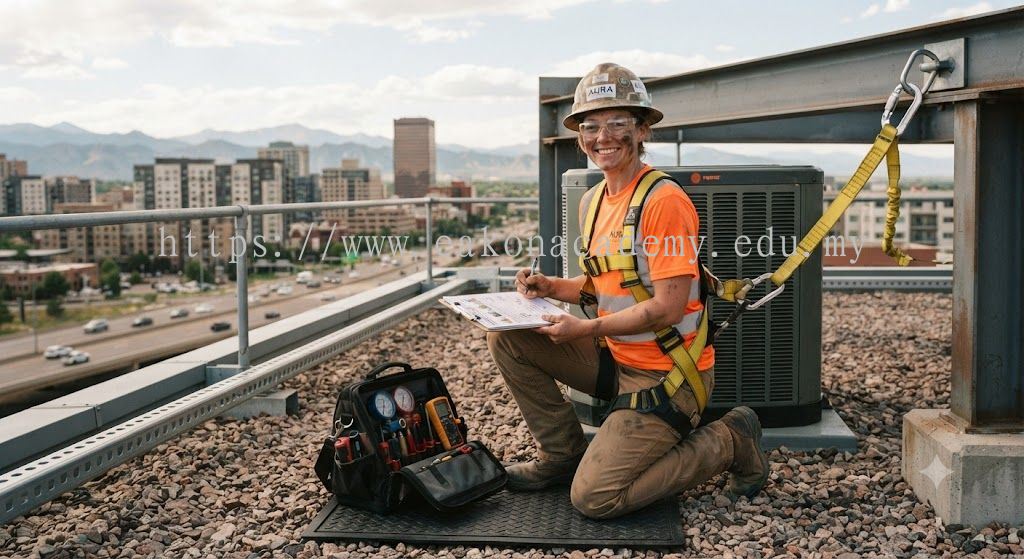
Fall prevention remains the cornerstone of effective aircon contractor maintenance height safety requirements. Wherever practical, engineering controls such as guardrails, roof edge protection systems, safety barriers, warning lines, and designated walkways should be installed to eliminate fall hazards. Where collective protection is not feasible, technicians must wear certified personal fall protection equipment, including full-body safety harnesses, energy-absorbing lanyards, self-retracting lifelines, and approved anchorage systems. Contractors should inspect all fall protection equipment before every use, checking for damaged webbing, worn stitching, defective connectors, corrosion, and other signs of deterioration. Proper training in harness fitting, anchor point selection, fall clearance calculations, and emergency rescue procedures ensures technicians can use fall protection systems safely and effectively throughout maintenance operations.
Personal protective equipment (PPE) is another essential component of maintenance height safety requirements. Air conditioning technicians should wear safety helmets with chin straps, slip-resistant safety footwear, cut-resistant gloves, eye protection, hearing protection where necessary, and high-visibility clothing suitable for the work environment. Respiratory protection may also be required when working around dust, insulation materials, mold, or refrigerants in poorly ventilated spaces. PPE should be regularly inspected, properly maintained, and replaced immediately if damaged or no longer compliant with safety standards. While PPE is an important safeguard, it should always be used alongside engineering controls, safe work procedures, and continuous supervision to provide comprehensive protection.
Electrical safety is particularly important during air conditioning maintenance activities because technicians often work with energized equipment, electrical control panels, motors, compressors, condensers, and power supplies. Maintenance height safety requirements should include lockout and tagout procedures where applicable, verification of power isolation, use of insulated tools, and testing to confirm circuits are de-energized before work begins. Proper grounding, cable management, and compliance with electrical safety regulations significantly reduce the risk of electric shock, arc flash incidents, and equipment damage during maintenance work.
Safe handling of maintenance tools, spare parts, and refrigerants also contributes to accident prevention. Air conditioning maintenance often requires vacuum pumps, refrigerant recovery machines, manifold gauges, leak detectors, pressure testing equipment, brazing tools, and portable power tools. These tools should be inspected before use and secured using tool lanyards where appropriate to prevent falling objects. Good housekeeping practices should be maintained throughout the work area to eliminate trip hazards caused by hoses, electrical cables, packaging materials, or loose components. Organized workspaces improve efficiency while reducing the risk of slips, trips, and falls.
Weather conditions should always be assessed before commencing rooftop HVAC maintenance. Heavy rain, strong winds, lightning, excessive heat, and poor visibility can significantly increase workplace hazards. Wet roofing materials become slippery, while strong winds can affect ladders, elevated work platforms, and technician stability. Supervisors should monitor weather conditions continuously and suspend maintenance activities whenever environmental conditions become unsafe. Clear stop-work procedures should be communicated to all personnel, ensuring workers understand when maintenance activities must be paused to protect their safety.
Emergency preparedness is another essential aspect of aircon contractor maintenance height safety requirements. Every maintenance project should include a documented emergency response plan covering falls, electrical incidents, refrigerant leaks, fire emergencies, medical situations, and severe weather evacuation procedures. Rescue equipment should be readily available, communication systems should remain operational, and technicians should understand their responsibilities during emergencies. Regular emergency drills, toolbox meetings, and rescue exercises help ensure workers can respond quickly and effectively should an incident occur.
Continuous training and competency development are fundamental to maintaining high safety standards within the HVAC maintenance industry. Air conditioning contractors should participate in regular training covering work-at-height safety, fall prevention, ladder safety, rooftop safety, risk assessment, electrical safety, PPE inspection, refrigerant handling, manual handling techniques, and emergency response. Ongoing education ensures technicians remain up to date with changing regulations, evolving HVAC technologies, and industry best practices. Well-trained employees perform maintenance tasks more safely, improve equipment reliability, and contribute to a stronger workplace safety culture.
At Eakon Academy (eakonacadem.edu.my), we are dedicated to developing highly skilled HVAC professionals through practical, industry-relevant training programs that combine technical excellence with workplace safety. Our courses focus on work-at-height safety, HVAC maintenance procedures, regulatory compliance, hazard identification, emergency preparedness, and fall protection systems to help contractors perform elevated maintenance work confidently and safely. By consistently following aircon contractor maintenance height safety requirements, HVAC companies can reduce workplace accidents, improve maintenance quality, strengthen legal compliance, protect valuable employees, and build long-term customer trust. Prioritizing height safety during air conditioning maintenance not only safeguards lives but also supports operational excellence, business sustainability, and a professional reputation for delivering safe, reliable, and high-quality HVAC maintenance services.
Tingnan ang karagdagang mga detalye tungkol sa EAKON ACADEMY SDN BHD
