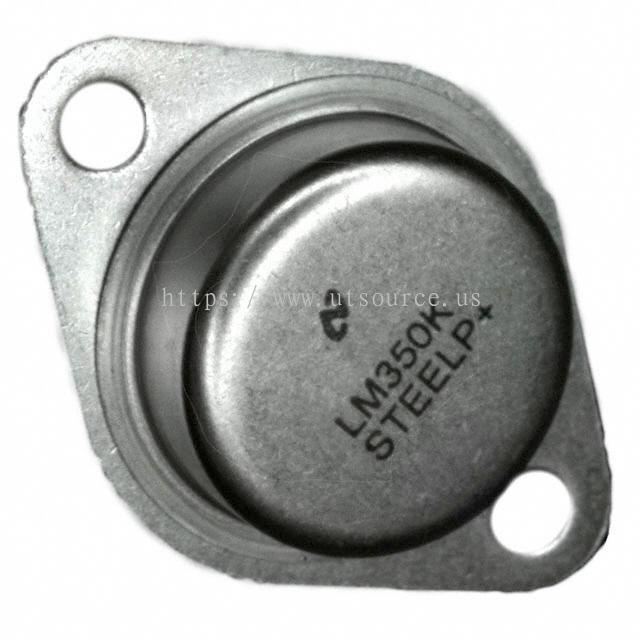
Description
BUY LM323K STEEL https://www.utsource.net/itm/p/999340.html
Three-terminal 3 A adjustable voltage regulators
| Parameter |
Symbol |
Min |
Typical |
Max |
Unit |
| Input Voltage |
VIN |
7 |
- |
40 |
V |
| Output Voltage |
VOUT |
5 |
5 |
5 |
V |
| Output Current (Max) |
IOUT |
- |
1.5 |
1.5 |
A |
| Quiescent Current |
IQ |
- |
5 |
10 |
mA |
| Dropout Voltage |
VD |
- |
2 |
2.5 |
V |
| Thermal Resistance (θJA) |
θJA |
- |
50 |
- |
°C/W |
| Operating Temperature |
Toper |
-40 |
- |
125 |
°C |
| Storage Temperature |
Tstg |
-65 |
- |
150 |
°C |
Instructions for Using the LM323K STEEL
Input Voltage (VIN):
- Ensure the input voltage is within the range of 7V to 40V.
- The input voltage must be at least 2V higher than the output voltage to maintain regulation.
Output Voltage (VOUT):
- The LM323K STEEL provides a fixed output voltage of 5V.
- No external components are required to set the output voltage.
Output Current (IOUT):
- The maximum continuous output current is 1.5A.
- For higher currents, consider using heat sinks or additional cooling methods.
Quiescent Current (IQ):
- The quiescent current is typically 5mA and can go up to 10mA.
- This current is drawn by the regulator itself and does not contribute to the load current.
Dropout Voltage (VD):
- The dropout voltage is the minimum difference between the input and output voltages required to maintain regulation.
- Typically, it is around 2V but can go up to 2.5V under certain conditions.
Thermal Management:
- The thermal resistance (θJA) is 50°C/W.
- Use a heatsink if the power dissipation exceeds safe levels to prevent overheating.
Operating Temperature (Toper):
- The operating temperature range is from -40°C to 125°C.
- Ensure the device operates within this range to avoid damage.
Storage Temperature (Tstg):
- The storage temperature range is from -65°C to 150°C.
- Store the device in a dry environment to prevent moisture damage.
Capacitors:
- Use a 10μF electrolytic capacitor on the input side and a 10μF electrolytic capacitor on the output side to ensure stability and reduce ripple.
- Additional capacitors may be necessary for specific applications to improve transient response.
PCB Layout:
- Place the input and output capacitors as close as possible to the regulator to minimize inductance and improve performance.
- Ensure good thermal management by providing adequate copper area for heat dissipation.
Safety:
- Always use appropriate fuses and protection circuits to prevent overcurrent and short-circuit conditions.
- Follow standard electrical safety guidelines when handling and testing the circuit.
(For reference only)
More detail about Utsource Holding Company Limited