
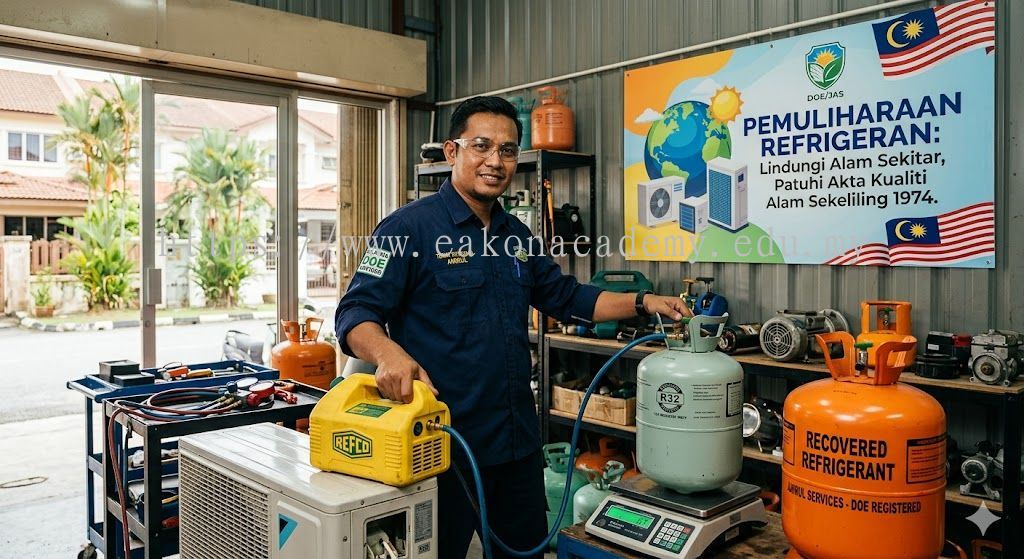
ENVIRONMENTAL REFRIGERANT CONTAINMENT MALAYSIA DOE – HVACR SUSTAINABILITY, EMISSION CONTROL AND ENVIRONMENTAL COMPLIANCE PRACTICES
Environmental refrigerant containment in Malaysia under the Department of Environment (DOE) framework is a critical component of sustainable HVACR (Heating, Ventilation, Air Conditioning, and Refrigeration) management. As the demand for cooling and refrigeration systems continues to grow across residential, commercial, and industrial sectors, the importance of preventing refrigerant emissions has become increasingly significant. Refrigerants such as hydrofluorocarbons (HFCs), hydrochlorofluorocarbons (HCFCs), and other fluorinated gases are widely used in HVACR systems, but many of these substances possess high global warming potential (GWP). When released into the atmosphere through leaks, improper servicing, or inadequate disposal practices, these gases contribute to climate change and environmental degradation. Therefore, environmental refrigerant containment Malaysia DOE initiatives play a crucial role in supporting national sustainability goals, environmental protection efforts, and regulatory compliance.
The primary objective of environmental refrigerant containment is to ensure that refrigerants remain securely contained within HVACR systems throughout their operational lifecycle. This includes every stage of system management, from design and installation to operation, maintenance, repair, refrigerant recovery, recycling, and final decommissioning. Proper containment practices help prevent accidental refrigerant releases, reduce greenhouse gas emissions, improve equipment performance, and extend system lifespan. For businesses and facility owners, effective refrigerant containment also contributes to reduced maintenance costs, improved energy efficiency, and stronger environmental responsibility.
Under environmental refrigerant containment Malaysia DOE guidelines, HVACR professionals are encouraged to adopt preventive measures that minimize the risk of refrigerant leakage. Proper system design, high-quality installation practices, and the use of reliable equipment components form the foundation of successful containment strategies. Technicians must ensure that piping systems, valves, fittings, compressors, condensers, and evaporators are correctly installed and tested to maintain system integrity. A properly installed HVACR system is less likely to experience refrigerant leaks and more likely to operate efficiently throughout its service life.
Routine maintenance is another essential aspect of environmental refrigerant containment. Scheduled inspections help identify potential problems before they result in refrigerant emissions. Technicians should regularly inspect system components for signs of wear, corrosion, vibration damage, loose connections, or seal deterioration. Preventive maintenance programs help detect issues early, reducing the likelihood of refrigerant loss and costly repairs. In addition, well-maintained systems typically consume less energy, contributing to lower operating costs and reduced environmental impact.
Leak detection plays a vital role in environmental refrigerant containment Malaysia DOE practices. HVACR professionals use a variety of approved techniques to identify refrigerant leaks, including electronic leak detectors, nitrogen pressure testing, ultraviolet (UV) dye testing, and soap bubble testing. These methods enable technicians to locate leaks accurately and perform repairs before significant refrigerant loss occurs. Continuous leak monitoring programs are especially important for large commercial and industrial refrigeration systems where refrigerant inventories may be substantial.
Refrigerant recovery and recycling are also fundamental elements of environmental containment. Before servicing or decommissioning HVACR equipment, refrigerants must be recovered using approved recovery machines and stored in certified recovery cylinders. Recovered refrigerants may then be recycled, reclaimed, or disposed of according to environmental regulations. Proper refrigerant recovery prevents direct atmospheric emissions and supports responsible resource management within the HVACR industry.
Malaysia’s environmental refrigerant containment initiatives are aligned with international agreements such as the Montreal Protocol and the Kigali Amendment. These global frameworks encourage countries to reduce reliance on high-GWP refrigerants and transition toward environmentally friendly alternatives such as R32, R290 (propane), ammonia, and carbon dioxide (CO ). As Malaysia advances toward more sustainable cooling solutions, effective refrigerant containment remains essential for ensuring environmental protection and regulatory compliance.
Professional training and competency development are critical to the successful implementation of environmental refrigerant containment Malaysia DOE practices. HVACR technicians must be equipped with the skills needed to perform leak detection, refrigerant recovery, system maintenance, and environmental compliance procedures. Institutions such as Eakon Academy (eakonacadem.edu.my) offer specialized HVACR training programs that provide both theoretical knowledge and practical experience in refrigerant management and environmental best practices. These programs help develop highly skilled professionals capable of supporting Malaysia’s environmental objectives and industry standards.
In conclusion, environmental refrigerant containment Malaysia DOE is a key strategy for reducing greenhouse gas emissions, improving HVACR system performance, and promoting sustainable development. Through proper installation, preventive maintenance, effective leak detection, responsible refrigerant recovery, comprehensive documentation, and professional training through Eakon Academy (eakonacadem.edu.my), the HVACR industry can significantly reduce its environmental footprint. By embracing these best practices, organizations and technicians can contribute to a cleaner, greener, and more environmentally responsible future for Malaysia.
Lebih maklumat tentang EAKON ACADEMY SDN BHD Malaysia
