Uniform Printing Method Comparison Guide
Choosing the wrong uniform printing method usually does not become obvious immediately.
The shirts may look fine during collection. The problems normally appear later — after repeated washing, long working hours, outdoor heat, or future reorders.
Some prints start feeling uncomfortable during full-day shifts. Some logos lose consistency between batches. Others simply do not hold up well once the uniforms become part of daily operations.
That is why experienced uniform suppliers rarely recommend one method for everything. The right choice depends on how the apparel will actually be used.
Quick Comparison of Uniform Printing Methods
| Method | Best For | Durability | Cost | Print Feel |
|---|---|---|---|---|
| Silkscreen | Bulk company uniforms | High | Lower for large quantity | Soft and breathable |
| DTF Heat Transfer | Small detailed orders | Medium | Medium | Slightly thicker |
| Sublimation | Sportswear and dry-fit apparel | High | Medium | Lightweight |
| Embroidery | Premium corporate uniforms | Very high | Higher | Textured and formal |
For most Malaysian businesses ordering long-term staff uniforms, silkscreen still remains the safest overall option because it balances durability, comfort, and cost better than most alternatives.
Why Silkscreen Still Dominates Corporate Uniform Printing
Despite newer technologies entering the market, silkscreen continues to be heavily used for factories, restaurant crews, retail uniforms, workshops, and large company orders.
There is a practical reason for that.
It survives daily wear well.
The print usually feels softer compared to large DTF applications, especially after long working hours. Wash resistance is also one of the main reasons businesses continue using it for operational uniforms.
Once quantities increase, the pricing becomes much more efficient too. Businesses ordering 100 pieces will usually get better long-term value from silkscreen than smaller-run methods.
It is not the best choice for every design, though. Extremely detailed graphics and complicated gradients can become restrictive depending on artwork complexity.
Businesses comparing bulk uniform solutions often review Silkscreen Printing Malaysia for Corporate Shirts & Uniforms before moving into larger production runs.
DTF Makes More Sense for Smaller Custom Orders
Not every company needs hundreds of uniforms.
Some only require 20 or 30 shirts for an event, campaign launch, promotional activity, or startup team. In those situations, DTF becomes much easier to manage.
The biggest advantage is flexibility.
Detailed logos, gradients, multi-colour artwork, and complex graphics can be produced without the heavier setup process associated with silkscreen printing.
But there is also a tradeoff many businesses only notice later.
Large DTF prints can feel warmer and heavier during extended wear, especially on full chest designs. For air-conditioned environments this may not matter much. For outdoor crews or physically active teams, it becomes more noticeable.
That is why DTF works better for campaign apparel, limited-run uniforms, promotional shirts, detailed graphic designs, and startup branding rather than heavy daily industrial use.
Sublimation Feels Completely Different During Actual Wear
Sublimation tends to stand out most once employees start wearing the uniforms for full-day activity.
Unlike traditional printing, the ink becomes part of the polyester fabric itself. There is no heavy print layer sitting on top of the shirt.
That changes the comfort level quite a bit.
For sports jerseys, delivery riders, outdoor teams, and dry-fit uniforms, sublimation usually feels noticeably lighter and more breathable in Malaysia’s weather.
It also solves one common frustration seen in lower-quality uniform printing: cracking and peeling after repeated washing.
Still, sublimation has a very important limitation — fabric compatibility.
It works primarily on polyester materials. Businesses expecting strong results on cotton uniforms usually end up disappointed if the wrong method is chosen.
Teams producing sportswear or activewear often compare options through How Sublimation Shirt Printing Supports Sports Apparel in Malaysia.
Embroidery Creates the Strongest Premium Appearance
For executive uniforms, hospitality apparel, hotel staff, and front-desk teams, embroidery usually creates the most polished appearance.
A stitched logo naturally looks more formal than standard printing. That alone changes how the uniform is perceived.
Small chest embroidery works especially well for corporate polos and management apparel.
But embroidery is not automatically “better” in every situation.
Large embroidered logos can feel stiff on thinner fabrics. Highly detailed artwork may also lose sharpness once converted into stitching.
Some businesses choose embroidery because it looks premium initially, then later realize it becomes too heavy for daily operational use on lighter garments.
That is why embroidery tends to work best when used selectively rather than aggressively.
A Simple Real-World Example
A restaurant team working near kitchen heat may choose silkscreen printing because the uniform needs to stay breathable, washable, and comfortable through long shifts.
A hotel reception team may choose embroidery instead because presentation matters more at the front desk. The logo area is usually smaller, the environment is less physically demanding, and the premium stitched finish supports a more polished brand image.
That is the real difference. The best method is not always the most expensive one. It is the one that fits the job.
Most Uniform Problems Come From Mismatched Decisions
Most businesses focus heavily on visual appearance during the ordering stage.
The operational problems usually appear later.
A print that feels acceptable during fitting may become uncomfortable after eight hours of physical work. A cheaper method may save money initially but create inconsistencies during future reorders.
That is why experienced suppliers evaluate more than artwork alone.
Fabric type, work environment, washing frequency, heat exposure, employee comfort, and reorder consistency all affect which method performs best long term.
Businesses planning repeat uniform programs often explore How to Manage Uniform Reorders Without Size or Color Issues before scaling larger orders.
How ND Silkscreen Trading Suggests Choosing the Right Method
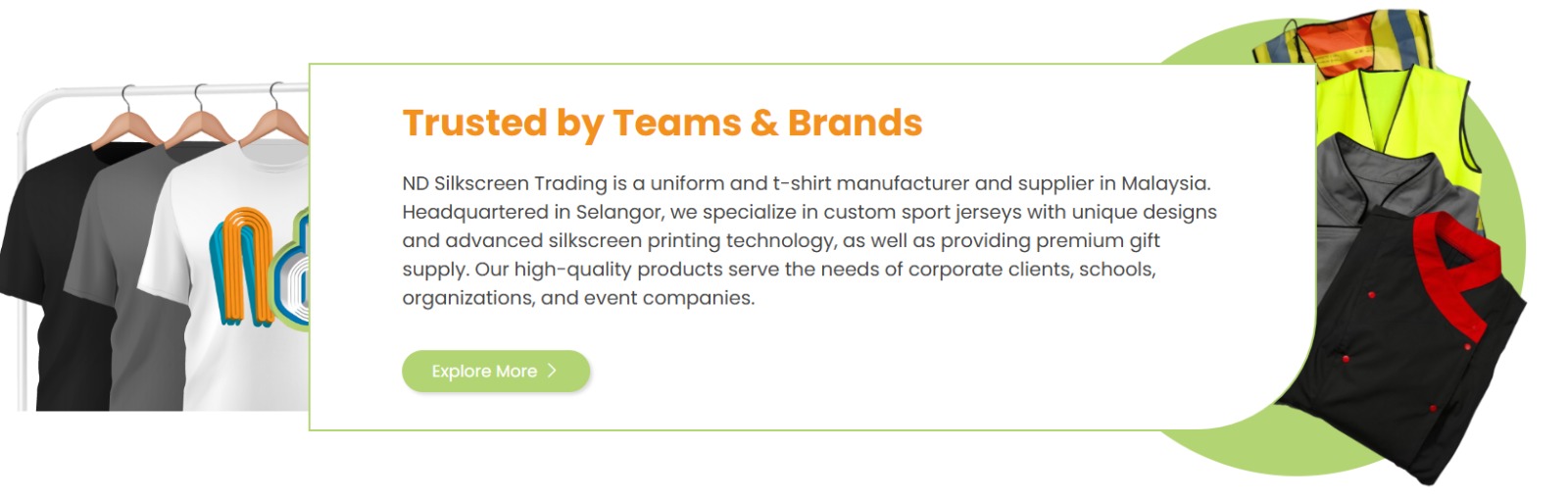
ND Silkscreen Trading approaches uniform printing as a practical business decision, not just a decoration choice.
The company considers fabric type, design complexity, order quantity, durability needs, budget, and usage environment before suggesting a method.
For cotton uniforms, silkscreen or embroidery usually makes more sense. For polyester dry-fit apparel, sublimation is often the better fit. For mixed fabrics, detailed logos, or small batches, DTF can be a practical option.
Quantity also changes the recommendation. Bulk orders usually favour silkscreen because the cost per piece becomes more efficient. Smaller batches with colourful artwork often suit DTF better.
The work environment matters just as much. A kitchen crew, warehouse team, office receptionist, outdoor rider, and corporate manager should not always be given the same printing solution.
Companies looking for broader uniform planning can refer to Company Uniform Printing Malaysia | Corporate & Staff Uniform Solutions.
Final Thoughts
Uniform printing problems rarely start on the first day.
They usually appear months later — when logos begin fading, staff start complaining about comfort, or reorders stop matching previous batches.
The best printing method is usually the one employees stop noticing because it continues working properly every day.

Register no. AS0422168-U