
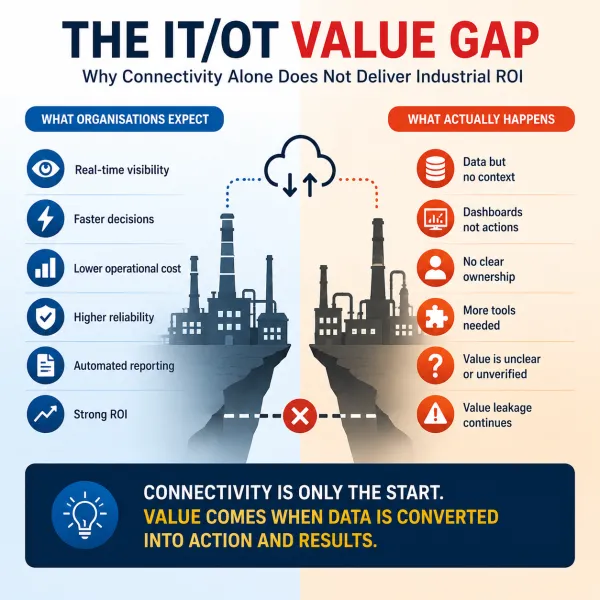
IT/OT integration rarely fails because data cannot be connected. It struggles because connected data is not automatically converted into decisions, actions and measurable outcomes.
In the first article, we discussed why organisations invest in IT/OT integration. The intention is valid. Industrial sites need better visibility, faster decisions, stronger reporting and a foundation for digital transformation.
But this is where many organisations face a hard reality. After the systems are connected, the return is not always clear. Dashboards are available. Data is flowing. Reports can be generated. Yet management still asks a practical question:
What value are we actually getting from this?
The integration layer moves the data. But the value layer must convert that data into context, action, ownership, verification and continuous improvement.
What Actually Happens After Integration
In many projects, the technical integration is completed successfully. OT systems are connected to historians, cloud platforms, dashboards or enterprise systems. Data that was previously trapped at plant level becomes visible to wider teams.
But after the first excitement, the organisation begins to see the second problem.
The data is connected, but not always usable. The dashboard is live, but not always actionable. The reports are available, but not always linked to decisions. The alerts are configured, but not always owned by the right team.
What Was Expected
The organisation expected connected data to quickly deliver operational improvement.
- Real-time visibility
- Faster decisions
- Lower energy cost
- Better asset reliability
- Automated reporting
- Clear digital transformation ROI
What Often Happens
The organisation discovers that integration is only the first layer of the value journey.
- Data needs cleaning and context
- Tags and assets are not standardised
- Dashboards show issues but do not assign actions
- No clear owner for the business outcome
- More software or analytics are required
- ROI becomes difficult to prove
Why the Cost Becomes Higher Than Expected
IT/OT integration looks simple in digitalisation presentations. In real industrial sites, it is usually more complex.
Many plants have mixed generations of equipment. Some systems are modern. Some are legacy. Some use open protocols. Some are vendor-locked. Some have clean data. Some have tags that nobody fully understands anymore.
Protocol and Gateway Work
Different systems may require Modbus, BACnet, OPC, MQTT, API, serial conversion, edge gateways or custom middleware.
Network and Cybersecurity
Segmentation, firewalls, DMZ design, user access, secure remote connection and IT security approval can extend the project.
Data Modelling
Tags must be named, mapped, structured, validated and linked to assets, systems, sites and business KPIs.
Software and Platform Layers
After the data is connected, more tools may be required for analytics, workflow, reporting, dashboards and AI-readiness.
This is why many organisations experience multiple rounds of spending. The first round connects data. The next round makes the data usable. Another round is needed to extract the actual value.
The Three Rounds of IT/OT Spending
This pattern is common. It does not mean the project has failed. It means the organisation underestimated what is required to move from data connection to value delivery.
Why Dashboards Alone Do Not Deliver Value
Dashboards are useful. They help make hidden information visible. But dashboards are not outcomes.
A dashboard may show that energy use has increased. It may show abnormal demand, compressor behaviour, chiller inefficiency or equipment runtime. But the dashboard itself does not decide what to do.
For value to be delivered, the system must answer:
Who Owns the Issue?
Is the action owned by maintenance, operations, engineering, energy team, production or management?
What Action Is Required?
Is the correct response operational change, maintenance work, setpoint review, procurement, capex or further study?
What Is the Value?
Does the issue carry energy cost, downtime risk, quality impact, compliance risk or production loss?
Was the Result Verified?
After action is taken, is the improvement measured, verified and reported as a business outcome?
Without this structure, dashboards become another reporting layer. They may look impressive, but they do not necessarily change how the plant operates.
The Hidden Problem: Data Without Context
Industrial data needs context. Without context, even accurate data can be difficult to use.
For example, an energy meter may show that consumption increased. But the system still needs to know whether production increased, whether the product mix changed, whether a standby load was running, whether the chiller plant was inefficient, or whether the site was operating outside normal hours.
Raw data can tell us what happened. Context helps explain why it happened.
To create value, industrial data must be linked to assets, operating schedules, production conditions, energy tariffs, maintenance events, responsibilities and business outcomes.
Why IT and OT Misalignment Slows the Value
IT and OT teams have different priorities, and both are valid.
IT teams normally focus on cybersecurity, data governance, cloud architecture, standardisation, access control and enterprise integration. OT teams focus on uptime, safety, machine reliability, process stability and avoiding operational disruption.
The problem happens when the project connects systems, but does not align the people and priorities behind those systems.
IT Priority
Secure architecture, standard platforms, controlled access, governance, cloud readiness and long-term system support.
OT Priority
Plant uptime, safety, fast troubleshooting, local control, reliable equipment and minimum disruption to production.
The value comes when these priorities are connected to a shared operational outcome.
The Real Value Chain
IT/OT integration only delivers ROI when the connected data travels through a full value chain.
If any link is missing, the value becomes weak. Data without context creates noise. Context without insight creates reports. Insight without action creates frustration. Action without verification creates uncertainty.
The return comes only when the full chain is managed.
The Energy Example: Why Connected Meter Data Is Not Enough
Energy management shows this value gap clearly. Many sites already have meters, EMS, BMS, SCADA, gateways or cloud dashboards. But energy waste still continues.
Why? Because visibility alone does not reduce energy. Energy savings need baseline, analysis, action ownership and verification.
This is where IoTWatt 4.0 is softly positioned as a value layer. It does not need to replace existing IT/OT infrastructure. It helps convert connected energy data into Digital Energy Audit, DEES action tickets, WattSave savings tracking and EECA-ready reporting.
The Main Lesson from Article 2
The main lesson is not that IT/OT integration is wrong. It is necessary. Organisations need connected data to modernise their operations.
But connectivity must not be confused with value.
Value is only delivered when connected data improves decisions, triggers action, assigns ownership and proves results.
Conclusion: The Real Work Starts After the Data Is Connected
Many organisations invest heavily in IT/OT integration and expect quick returns. Some do achieve results, but usually after they build the missing value layer: data context, analytics, workflow, ownership, verification and continuous improvement.
This is the reality of industrial digitalisation. The integration project may be completed, but the value journey is only beginning.
IT/OT integration connects the systems. Value is delivered only when connected data becomes operational action and measurable results.

 Malaysia